How Road Conditions Affect Electric Scooter Range and Performance
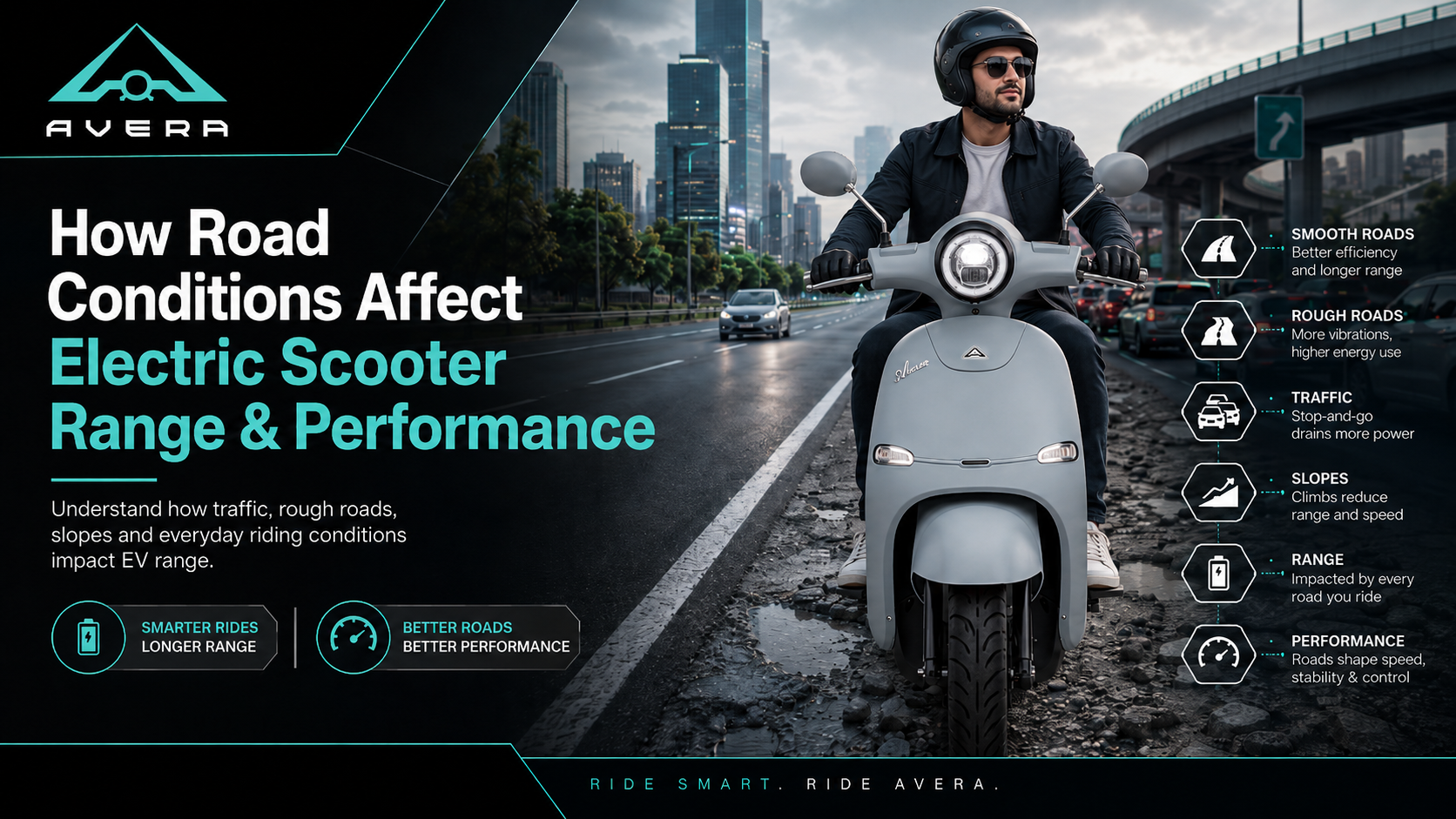
Electric scooter range is not determined by battery capacity alone. The roads you ride on every day can have a direct effect on energy consumption, comfort, speed, braking, acceleration and overall performance. In Indian cities, where road quality can change from smooth highways to broken internal roads, understanding how road conditions affect an electric scooter can help buyers choose a more suitable vehicle for daily use.
Your real-world electric scooter range can vary depending on traffic, road surface, gradients, passenger load and riding pattern. The best scooter is one that performs comfortably on the roads you actually use.
Why Road Conditions Matter for Electric Scooter Buyers
Many buyers compare electric scooters using claimed range figures, but everyday performance depends on more than one number. AVERA's buying guidance recommends that customers understand the type of roads they use, their daily kilometres, passenger use and charging access before selecting a scooter.
This matters because the same scooter may behave differently on a smooth urban road, a congested route, an uneven street or a road with frequent slopes. Road conditions influence how much energy the motor needs, how often the rider accelerates and brakes, and how comfortable the scooter feels over longer journeys.
1. Smooth Roads Usually Support More Efficient Riding
Smooth, well-maintained roads generally allow an electric scooter to maintain speed with fewer interruptions. When the rider can move at a steady pace without frequent braking or sudden acceleration, the vehicle may use energy more efficiently.
Predictable urban roads can also make it easier to estimate practical daily range because the riding pattern is more consistent.
Roads That Support Consistent Riding
- Smooth city roads
- Predictable urban routes
- Moderate traffic conditions
- Fewer sudden stops
- Relatively level road surfaces
2. Broken and Uneven Roads Can Affect Performance
Uneven roads often require the rider to slow down, accelerate again, avoid potholes and make more steering corrections. This can change the way energy is used during a journey.
These roads can also make suspension quality, tyre condition and braking confidence more important. A scooter that appears suitable on paper should still be evaluated for the kind of roads you travel on every day.
AVERA's source recommends comparing the complete vehicle, including tyres, suspension, braking, ergonomics and build quality, rather than focusing only on battery specifications.
3. Stop-and-Go Traffic Can Increase Energy Use
Indian city traffic often involves frequent stops, slow movement and repeated acceleration. This type of riding can produce a different real-world range compared with a smoother and more consistent route.
Every time the scooter slows down and accelerates again, the motor must respond to changing load conditions. This is why a daily commute through dense traffic can feel different from the same number of kilometres on a more open road.
Buyers should therefore estimate their range requirement based on their real commuting conditions rather than assuming the highest advertised range will always be achieved.
4. Slopes and Flyovers Can Change Energy Demand
Roads with frequent inclines, bridges and flyovers can place greater demand on the motor compared with flat routes. The scooter needs more energy to move the same load uphill.
If your daily route includes many slopes, this should be considered when deciding how much practical range you need.
If your commute includes steep or repeated inclines, leave a wider range margin rather than choosing a scooter whose expected range only just matches your daily distance.
5. Passenger Load Matters Even More on Difficult Roads
Carrying a passenger adds extra load to the scooter. On smooth roads, the impact may be easier to manage, but on slopes, broken roads or congested routes, the effect can become more noticeable.
AVERA's guidance recommends that buyers consider whether they regularly carry a passenger when evaluating their commute.
If you frequently ride with another person, evaluate comfort, acceleration, braking and range under realistic conditions during a test ride.
6. Tyres Influence Efficiency and Road Confidence
Tyres are a major contact point between the scooter and the road. Their condition, size, grip and inflation can influence how the vehicle feels and how efficiently it moves.
Poor tyre condition or incorrect pressure can make the scooter harder to roll and may affect stability and energy use.
For city riders, tyre suitability should be checked together with the road conditions encountered on the normal commute.
7. Suspension Quality Affects Comfort and Control
Suspension is especially important on roads with speed breakers, patches, potholes and uneven surfaces.
A good suspension setup can make daily riding more comfortable and help the scooter remain more stable when the surface changes unexpectedly.
This is one reason why buyers should compare the complete vehicle, not just range and battery capacity.
8. Braking Behaviour Changes With Road Surface
Braking performance can feel different on clean dry roads, loose surfaces or wet roads. Riders should evaluate braking confidence as part of the overall vehicle assessment.
Frequent stop-and-go traffic also means brakes may be used more often during city commuting. This makes braking quality especially important for everyday urban use.
| Road Condition | Possible Effect | What to Check |
|---|---|---|
| Smooth Roads | More consistent riding | Comfort and practical range |
| Heavy Traffic | Frequent acceleration and braking | Real-world range and braking |
| Broken Roads | More speed changes and vibration | Suspension, tyres and build quality |
| Slopes | Higher motor demand | Performance and range margin |
| Wet Roads | Reduced grip confidence | Tyres and braking behaviour |
9. Weather and Wet Roads Add Another Variable
Wet roads can change traction, braking behaviour and riding confidence. Riders may also travel more slowly or change routes during heavy rain.
This can influence real-world performance compared with riding in clear and dry conditions.
Buyers should therefore consider the conditions they commonly experience throughout the year rather than judging the vehicle only on one test ride.
10. Real-World Range Should Include a Safety Margin
If your daily commute is 30 kilometres, choosing a scooter based only on a range figure that barely exceeds 30 kilometres may not give enough flexibility for road conditions, traffic diversions or unexpected trips.
AVERA recommends comparing usable range for real riding conditions.
A sensible range margin gives you more flexibility when the road is slower, rougher or more demanding than expected.
11. Charging Access Still Matters
Difficult road conditions can increase uncertainty around range, making reliable charging even more important.
Before buying, identify where you will normally charge, whether the electrical connection is suitable and how long charging takes. Apartment residents should also confirm permissions, electrical access, metering and safe charging arrangements.
Convenient charging can make it easier to manage variations in daily energy use.
12. Test Ride on Roads Similar to Your Daily Route
A showroom test ride on a smooth road may not tell you how the scooter will feel on your actual commute.
If possible, evaluate the scooter on roads that resemble your normal riding conditions.
During the Test Ride, Check:
✓ Acceleration in traffic
✓ Braking confidence
✓ Suspension over uneven sections
✓ Low-speed control
✓ Comfort on speed breakers
✓ Performance with a passenger if relevant
13. Road Conditions Also Affect Ownership Cost
Rough roads and demanding usage can also influence maintenance needs. Tyres, suspension and other components may experience different levels of wear depending on riding conditions.
This is another reason to look beyond purchase price and consider total cost of ownership.
AVERA's source recommends including energy, maintenance, insurance, financing, tyres, battery warranty and resale considerations when evaluating ownership economics.
Choosing the Right AVERA Scooter for Your Roads
AVERA's product portfolio is positioned around different urban mobility needs. The right model should be chosen according to intended use, performance expectations, range requirements, budget and preferred features.
AVERA VINCERO is positioned for customers looking for a more performance-oriented electric two-wheeler experience.
AVERA RETROSA is designed around a distinctive premium urban-scooter proposition, while RETROSA Lite e is positioned as an accessible option for buyers entering electric mobility.
Exact specifications, prices and availability may change, so buyers should check the latest official information and take a proper test ride before deciding.
Road-Condition Buying Checklist
- Identify the roads you use most often.
- Calculate your average daily kilometres.
- Consider traffic and stop-start riding.
- Check whether your route has frequent slopes.
- Consider regular passenger use.
- Evaluate tyre and suspension suitability.
- Compare usable range with a reasonable margin.
- Confirm reliable charging access.
- Check service coverage and spare-parts availability.
- Take a proper test ride under realistic conditions.
Frequently Asked Questions
Do rough roads reduce electric scooter range?
Rough roads can change riding speed, acceleration and braking patterns, which may affect real-world energy use compared with smoother routes.
Does traffic affect electric scooter range?
Yes. Frequent stopping and acceleration can produce different energy consumption from steady-speed riding.
Do hills affect electric scooter performance?
Inclines can increase motor demand, so buyers with hilly or flyover-heavy routes should consider a wider practical range margin.
Does carrying a passenger affect EV range?
Passenger load can affect performance and energy consumption, particularly on difficult roads or slopes.
Why are tyres important for an electric scooter?
Tyres affect grip, rolling behaviour, comfort and stability, so they are especially important on uneven or wet roads.
Does suspension affect range?
Suspension mainly affects comfort and control, but road quality can influence overall riding behaviour and how efficiently the scooter is used.
Should I trust claimed range figures?
Claimed range can help with comparison, but buyers should also consider usable range under their own road, traffic, load and riding conditions.
Should I test ride an electric scooter before buying?
Yes. A proper test ride helps you assess performance, braking, suspension and comfort on conditions similar to your normal commute.
Conclusion
Road conditions play an important role in electric scooter range and performance. Smooth roads, heavy traffic, potholes, slopes, wet surfaces and passenger use can all change how the scooter behaves in real-world riding.
That is why buyers should not choose an electric scooter based only on advertised range or battery capacity. Understand your daily roads, evaluate the complete vehicle and leave enough range flexibility for less-than-ideal conditions.
AVERA's broader buying guidance supports this practical approach: understand your travel pattern, road type, charging access, usable range, service support and ownership economics before booking.
About AVERA
AVERA is an electric two-wheeler manufacturer from Andhra Pradesh, India, focused on sustainable mobility, engineering and product development. The company is building capabilities across electric vehicle manufacturing, battery-pack integration and R&D.