Daily Kilometres and Usage Pattern: How to Choose the Right Electric Scooter for Your Commute
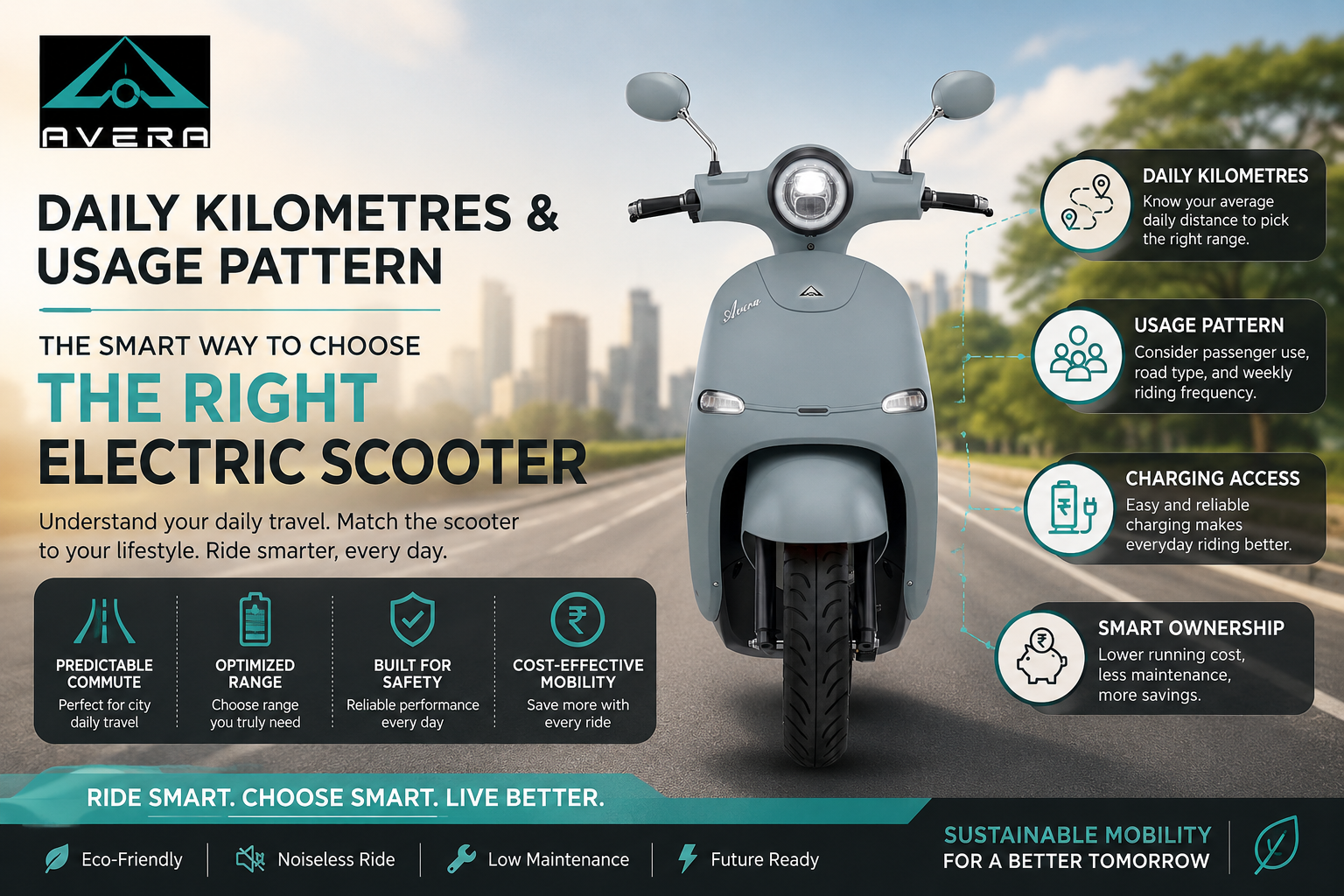
Choosing an electric scooter should start with one practical question: how do you actually travel every day? Before comparing range, battery size, offers or features, understanding your daily kilometres and usage pattern can help you decide whether a particular electric scooter will genuinely fit your routine.
The right electric scooter is not necessarily the one with the biggest claimed range. It is the one that comfortably matches your normal daily travel, charging access, road conditions and ownership needs.
Why Daily Kilometres Matter Before Buying an Electric Scooter
Before comparing different electric scooters, it is important to understand your own commute. The AVERA buying guide recommends estimating your average daily kilometres, how many days you ride each week, whether you regularly carry a passenger, the type of roads you normally use and where the scooter can be charged. :contentReference[oaicite:0]{index=0}
This matters because the value of an electric scooter depends heavily on how it is used. A person travelling a predictable urban route every day may have very different requirements from someone who makes long, irregular journeys or frequently travels outside the city.
Instead of starting with advertisements or headline specifications, begin with your own routine. Your travel pattern should guide the choice of vehicle.
1. Calculate Your Average Daily Kilometres
Start by calculating how far you normally travel in a day. Include the complete distance from home to work, college, business locations, markets and any other regular stops.
For example, if your workplace is 12 kilometres from home, your basic round trip is approximately 24 kilometres. If you regularly add another 5 to 10 kilometres for errands, your actual daily usage may be closer to 30 or 35 kilometres.
This calculation gives you a more useful starting point than simply asking, “What is the maximum range of this scooter?”
| Daily Usage Pattern | What to Consider |
|---|---|
| Short Daily Commute | Charging convenience, comfort, service access and suitable real-world range. |
| Medium Urban Commute | Usable range, battery performance, daily charging routine and traffic conditions. |
| Long or Irregular Travel | Real-world range, charging time, service availability and charging infrastructure. |
| Frequent Passenger Use | Performance, comfort, suspension, braking and expected operating range. |
2. Look at Your Weekly Riding Pattern
Daily kilometres tell only part of the story. You should also understand how often the scooter will be used during the week.
Someone who travels 25 kilometres every day for six days a week may use the scooter much more intensively than someone who rides 40 kilometres only once or twice a week.
The AVERA guide specifically recommends considering the number of days you ride each week when assessing whether an electric scooter fits your requirements.
This information can also help you estimate energy consumption and compare the broader ownership economics of an electric scooter with a conventional petrol scooter.
3. Consider Whether You Regularly Carry a Passenger
Your actual usage pattern should include whether you usually ride alone or frequently carry another person.
Carrying a passenger changes the total operating load on the scooter. This means buyers should not assess a vehicle only under ideal or solo-riding conditions.
If your normal routine includes a passenger, check whether the scooter feels comfortable and suitable during a proper test ride. Evaluate the seating position, suspension, braking, acceleration and overall riding confidence.
AVERA recommends considering passenger usage as part of understanding the real daily commute before selecting a scooter.
4. Road Conditions Are Part of Your Usage Pattern
Two people may travel the same number of kilometres every day but have very different riding conditions.
One person may travel mainly on smooth urban roads, while another may regularly encounter uneven surfaces, heavy traffic, frequent stop-start riding or more demanding routes.
That is why the type of roads you use should be considered alongside daily distance. The original AVERA content highlights road type as one of the basic factors buyers should examine before comparing electric scooters.
Road and traffic conditions can affect how the vehicle performs in everyday use, so real-world suitability matters more than a specification viewed in isolation.
5. Predictable Urban Travel Can Suit Electric Scooters Well
Electric scooters can be especially practical when daily travel is relatively predictable and charging is convenient.
According to the AVERA guide, buyers travelling predictable urban distances and able to charge conveniently at home or work may find an electric scooter particularly practical.
A predictable commute makes it easier to understand how much range is actually required. It also allows the owner to establish a regular charging routine instead of depending on uncertain charging opportunities.
Practical Example
If your commute is roughly the same every weekday and you have reliable charging access at home, you can evaluate a scooter based on that real routine rather than selecting the vehicle with the highest advertised range.
6. Longer or Irregular Journeys Need More Planning
Buyers with longer or less predictable journeys should take a more detailed approach.
The AVERA material recommends paying closer attention to real-world range, charging time, service availability and the availability of charging infrastructure along regular routes when travel is longer or irregular.
If your daily route changes frequently, ask yourself whether the scooter provides enough flexibility for those changes. Also consider what happens when an unexpected journey is added to your routine.
Understanding this before purchase can help avoid choosing a vehicle purely because its claimed range appears attractive.
7. Charging Access Should Match Your Daily Routine
Daily kilometres and charging access should always be evaluated together.
Before buying an electric scooter, identify where you normally expect to charge it, whether the electrical connection is suitable and how long charging takes. You should also understand what charging options are available if your routine changes.
Apartment residents and people using shared parking should pay particular attention to permissions, electrical access, metering and safe charging arrangements.
A scooter may have sufficient range for your daily kilometres, but the ownership experience may still become difficult if regular charging is inconvenient.
8. Do Not Choose a Scooter Using Range Alone
Range is important, but a scooter should be evaluated as a complete vehicle.
The AVERA guide recommends looking at the motor and controller, brakes, tyres, suspension, lighting, software, instrumentation, safety systems, ergonomics, build quality, service network and spare-parts availability.
This is especially important because two vehicles that appear similar on paper may provide different experiences in your actual riding conditions.
The goal should be to find a vehicle that works well for your daily kilometres, road conditions and normal use rather than simply choosing the highest specification.
9. Daily Usage Also Affects Total Cost of Ownership
Your daily kilometres can influence how valuable an electric scooter may be over the period you own it.
The AVERA source recommends comparing the cost of energy, routine maintenance, insurance, financing, tyres, expected battery warranty and resale considerations instead of looking only at the purchase price.
A simple approach is to estimate your annual travel distance and compare the expected EV energy cost with the fuel cost of a comparable petrol scooter. Then add the likely maintenance and financing differences.
Because usage varies from one buyer to another, AVERA recommends calculating ownership economics using your own kilometres and local prices rather than depending on a generic savings claim.
10. Create a Personal Commute Profile Before Visiting a Dealer
One of the simplest ways to make a better purchase decision is to create a small profile of your normal travel pattern before visiting a showroom.
- Average kilometres travelled each day
- Number of riding days per week
- Regular passenger use
- Typical road and traffic conditions
- Normal charging location
- Occasional longer journeys
- Expected real-world range requirement
- Service availability in your area
- Budget and financing requirements
- Expected period of ownership
AVERA's own buyer checklist starts with calculating average daily kilometres and confirming where and how the scooter will be charged. It also recommends comparing usable range for real riding conditions, checking the complete on-road price, service availability and warranty terms, and taking a proper test ride.
Choosing the Right AVERA Scooter for Your Usage Pattern
AVERA's product portfolio is designed around different urban mobility requirements. The source material states that the right model should be selected according to intended use, performance expectations, range requirements, budget and preferred features.
AVERA VINCERO is positioned for customers looking for a more performance-oriented electric two-wheeler experience. AVERA RETROSA is positioned around a distinctive premium urban-scooter proposition, while RETROSA Lite e is positioned as a more accessible entry into electric mobility.
Exact specifications, prices, availability and offers may change, so buyers should refer to current official product information and an authorised dealer when making a purchase decision.
Frequently Asked Questions
Why should I calculate daily kilometres before buying an electric scooter?
Calculating daily kilometres helps you understand the amount of range you actually require and whether the scooter fits your normal travel routine.
Is the scooter with the highest claimed range always the best choice?
No. A scooter should match your real travel requirements, charging access, road conditions, passenger usage and service needs.
Are electric scooters suitable for daily city commuting?
The AVERA guide states that electric scooters can be particularly practical for buyers with predictable urban travel and convenient charging access.
What should I consider if I regularly travel longer distances?
Pay closer attention to real-world range, charging time, service availability and charging infrastructure along your routes.
Should passenger use be considered when choosing an electric scooter?
Yes. AVERA recommends considering whether you regularly carry a passenger as part of understanding your daily travel pattern.
Why is charging access important if my daily travel is short?
Even if your normal commute is short, reliable and convenient charging remains an important part of the overall ownership experience.
How can I estimate whether an electric scooter makes financial sense?
Compare your estimated annual EV energy cost with the fuel cost of a comparable petrol scooter and consider maintenance and financing differences using your own kilometres and local prices.
Conclusion
Daily kilometres and usage pattern should be among the first things you evaluate when choosing an electric scooter.
Start with your real commute: how far you travel, how often you ride, whether you carry a passenger, what roads you use and where you can charge. Then compare real-world range, charging convenience, vehicle quality, service support and ownership economics.
The AVERA guide ultimately makes a simple but important point: the smartest time to buy is when the product matches your mobility needs, the ownership economics work for you and the supporting ecosystem is ready.
About AVERA
AVERA is an electric two-wheeler manufacturer from Andhra Pradesh, India, focused on sustainable mobility, engineering and product development. The company is building capabilities across electric vehicle manufacturing, battery-pack integration and R&D.