How to Choose the Right Electric Scooter for City Commuting in India
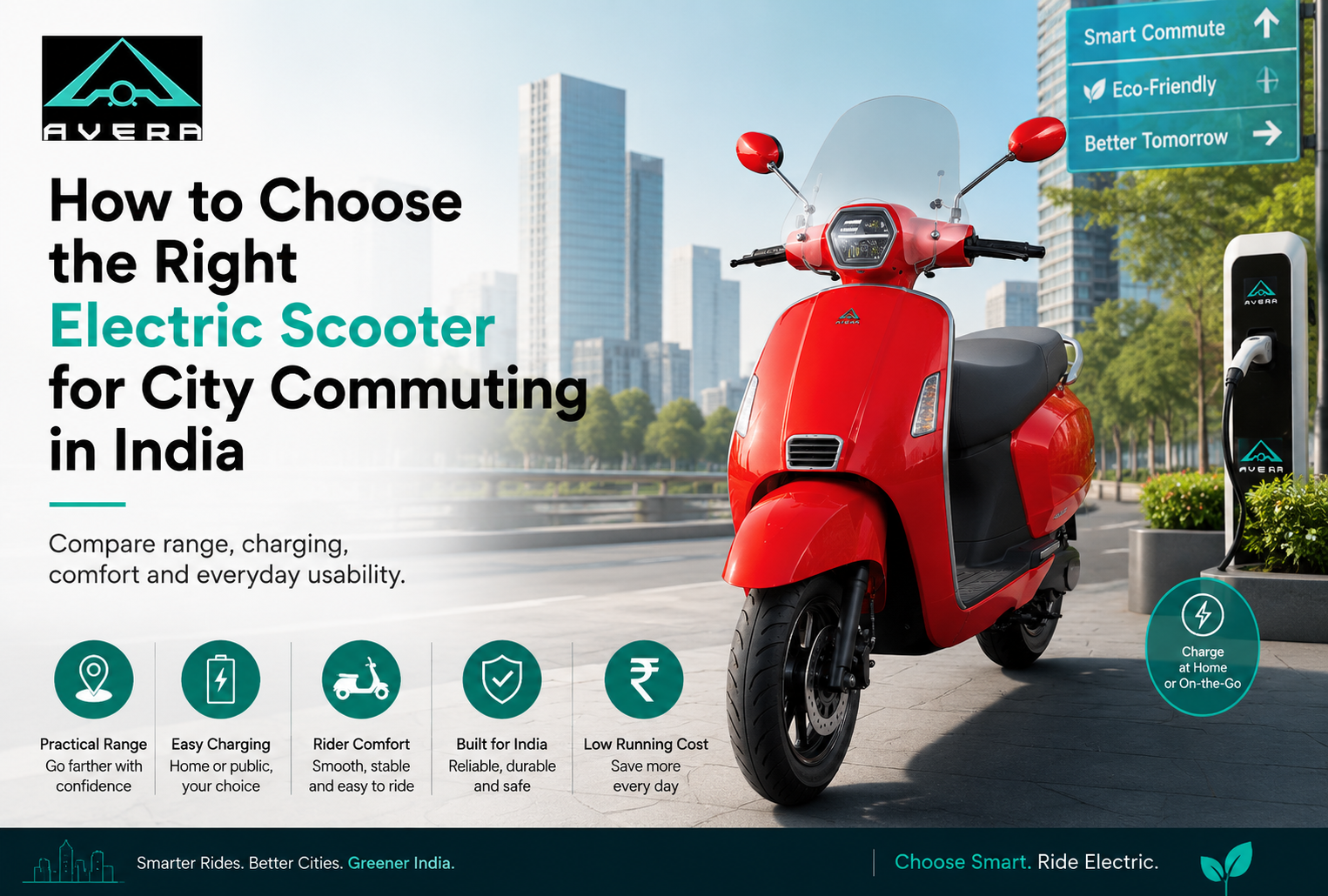
City commuting in India can involve traffic, short frequent trips, uneven roads, passenger use, limited parking and the need for dependable daily mobility. That is why choosing an electric scooter for urban travel should involve more than looking at price or claimed range. The right scooter is one that matches your daily kilometres, charging access, road conditions, comfort expectations, service support and total ownership needs.
For city commuting, choose an electric scooter that comfortably covers your real daily distance, can be charged conveniently, handles your normal road and passenger conditions, and has dependable service and warranty support.
Why Electric Scooters Can Suit Urban Commuting
Electric two-wheelers are particularly relevant for Indian cities because much of everyday travel consists of short- and medium-distance commuting. Electric scooters can offer quiet operation, instant motor response and the potential for lower routine energy and maintenance costs compared with conventional petrol scooters.
However, the real value depends on how the scooter is used, local electricity and fuel prices, charging access, service support and the individual product. That is why buyers should begin with their own commuting pattern rather than choosing only by specifications.
1. Start With Your Daily Kilometres
The first step is to calculate how many kilometres you normally travel each day. Include your complete round trip to work, college or business locations, along with regular shopping and personal travel.
Also think about how many days you ride each week. A rider travelling 25 kilometres every day may have different needs from someone who travels 50 kilometres only occasionally.
Daily Commute Checklist
- Average kilometres travelled each day
- Number of riding days each week
- Occasional longer journeys
- Passenger use
- Road and traffic conditions
- Where the scooter can be charged
A predictable daily commute makes it much easier to decide what range and charging routine you actually need.
2. Choose Real-World Range, Not Just Claimed Range
Range is one of the first specifications buyers compare, but the highest claimed number is not automatically the best choice.
A practical approach is to choose a scooter whose usable range comfortably covers your daily commute while leaving enough flexibility for traffic diversions, additional errands or occasional extra kilometres.
If your travel pattern is predictable and charging is available at home or work, an electric scooter can be particularly practical. If your journeys are longer or irregular, pay closer attention to real-world range, charging time and charging availability along your routes.
| Commute Type | Main Priority | What to Check |
|---|---|---|
| Short Urban Commute | Convenience | Charging, comfort and service access |
| Medium Daily Commute | Usable range | Range, charging time and road conditions |
| Long or Irregular Commute | Flexibility | Real-world range and charging infrastructure |
| Frequent Passenger Use | Comfort and performance | Suspension, braking, ergonomics and range |
3. Check Where You Will Charge the Scooter
Charging convenience can make or break the ownership experience. Before booking an electric scooter, identify exactly where you expect to charge it most of the time.
For many city commuters, home charging may be the simplest option. Others may have workplace charging or another reliable parking location.
Check whether the electrical connection is suitable, how long charging takes and what backup option is available if your normal routine changes.
Charging Questions to Ask
✓ Can I charge at home?
✓ Is the electrical connection appropriate?
✓ How long does charging take?
✓ Is workplace charging available?
✓ What happens if my normal charging location is unavailable?
4. Apartment Residents Should Plan Before Delivery
City residents often live in apartments or use shared parking. In these situations, charging should be planned before the scooter is delivered.
Buyers should understand whether charging is permitted, how electrical access will be provided, how electricity will be metered and whether the charging setup is safe and convenient.
This can prevent a common problem: buying a suitable electric scooter but discovering later that regular charging is difficult.
5. Consider City Road Conditions
Urban commuting is rarely identical from one city or neighbourhood to another. Some riders travel mainly on smooth main roads, while others deal with speed breakers, uneven surfaces, narrow lanes, frequent stopping or heavier traffic.
That is why the complete vehicle should be evaluated, not just the battery or motor.
Look at suspension, tyres, braking, seating position, ground clearance where relevant, ergonomics and overall build quality. A scooter that looks impressive on a specification sheet should also feel suitable on the roads you actually use.
6. Think About Passenger Use
If you regularly carry a family member, colleague or passenger, evaluate the scooter for that real-world use.
Passenger weight and total load can influence performance and energy consumption, so a test ride should reflect your normal riding pattern wherever possible.
Pay attention to seat comfort, suspension, braking confidence, acceleration and balance.
7. Understand the Battery and BMS
Battery technology is one of the most important parts of an electric scooter, but buyers should look beyond capacity alone.
Ask about battery chemistry, usable capacity, Battery Management System functionality, warranty coverage, expected operating conditions and manufacturer service support.
AVERA identifies battery engineering as a core part of its product ecosystem and has developed in-house LFP battery-pack assembly capabilities.
LFP, or lithium iron phosphate, is widely valued for safety characteristics and cycle-life potential. However, overall performance depends on the complete pack design, cells, BMS, thermal management, charging strategy and vehicle integration.
8. Compare the Complete Vehicle
A good city electric scooter is an integrated system. Do not choose a scooter only because one specification looks better than a competitor.
Compare:
Check whether performance suits your everyday urban riding.
Important for frequent stop-start city traffic.
Evaluate comfort on the roads you regularly use.
Check visibility and ease of reading information.
Comfort matters when the scooter is used every day.
Check service access and spare-parts availability.
9. Calculate the Total Cost of Ownership
Purchase price is only the first number. A better comparison includes charging expense, routine maintenance, insurance, financing, tyres, battery warranty and resale considerations over the period you expect to own the vehicle.
A simple approach is to estimate your annual kilometres and compare the annual EV energy expense with the fuel expense of a comparable petrol scooter.
Then add expected maintenance and financing differences.
Use your own kilometres, local electricity tariff and local petrol price rather than depending on a generic savings claim.
10. Compare Financing, Not Just EMI
Monthly EMI can make a scooter look affordable, but it does not show the complete financing expense.
Compare the down payment, interest rate, tenure, processing charges and total amount payable. A lower EMI over a longer tenure may still result in a higher overall financing cost.
11. Check Government Incentives Carefully
Government EV incentives may influence the final purchase price, but they should not be treated as permanent discounts.
Eligibility can depend on the applicable programme, vehicle category, model eligibility, certification, registration timing and other conditions.
Confirm current eligibility using official information and verify the applicable benefit with the authorised dealer before making payment.
12. Check Service Network and Spare Parts
A city commuter may depend on the scooter almost every day, so after-sales support matters.
Before purchasing, check whether service is reasonably accessible in your area and whether spare parts can be obtained through the manufacturer's support network.
A lower upfront price may not represent better value if servicing is inconvenient or the product does not suit your daily needs.
13. Always Take a Proper Test Ride
Specifications can narrow down your options, but a test ride can reveal things that are difficult to judge online.
During the test ride, evaluate:
- Riding position
- Seat comfort
- Acceleration response
- Braking confidence
- Suspension comfort
- Low-speed control
- Instrument visibility
- Overall ease of use
City Commuter Electric Scooter Buying Checklist
- Calculate your average daily kilometres.
- Identify where and how you will charge.
- Compare usable range for real riding conditions.
- Consider passenger and road conditions.
- Understand battery chemistry, BMS and warranty.
- Compare motor, brakes, tyres and suspension.
- Check the complete on-road price.
- Compare total financing cost.
- Verify service and spare-parts availability.
- Take a proper test ride before booking.
Choosing the Right AVERA Scooter for City Travel
AVERA's product portfolio is designed around different urban mobility needs. The appropriate model should be chosen according to your intended use, performance expectations, range requirement, budget and preferred features.
AVERA VINCERO is positioned for customers looking for a more performance-oriented electric two-wheeler experience.
AVERA RETROSA is designed around a distinctive premium urban-scooter proposition, while RETROSA Lite e is positioned as an accessible option for customers entering electric mobility.
Exact specifications, pricing, offers and availability can change, so buyers should always check the latest official AVERA product information and authorised dealer details before purchase.
Frequently Asked Questions
Is an electric scooter good for city commuting in India?
It can be particularly practical for predictable short- and medium-distance urban travel when convenient charging and suitable service support are available.
How much range do I need for daily city travel?
Start with your average daily kilometres and choose usable range that comfortably covers your normal commute with additional flexibility for unexpected trips.
Should I buy the electric scooter with the highest range?
Not necessarily. Range should be considered alongside charging access, comfort, road suitability, warranty and service support.
Can I use an electric scooter for office commuting?
Yes, especially when your daily route is predictable and you have reliable charging access at home or work.
What should apartment residents check before buying?
Confirm charging permission, electrical access, metering and safe charging arrangements before delivery.
Does carrying a passenger affect electric scooter usage?
Passenger load is part of real-world usage and should be considered when evaluating performance, comfort and range.
What matters more: battery or motor?
Both are part of an integrated system. Buyers should compare battery, BMS, motor, controller, brakes, tyres, suspension and software together.
Should I compare EV charging cost with petrol expense?
Yes. Use your annual kilometres and local electricity and petrol prices to make a more realistic ownership-cost comparison.
Is a test ride really necessary?
Yes. A test ride helps you assess comfort, handling, acceleration, braking and overall suitability for your daily commute.
Conclusion
The right electric scooter for city commuting is not necessarily the cheapest model or the one with the largest advertised range.
A better choice begins with your actual routine. Calculate your daily kilometres, understand where you will charge, consider your road and passenger conditions, compare realistic range and evaluate the complete vehicle.
Also consider ownership cost, battery warranty, financing, service availability and spare-parts support. When these factors work together, an electric scooter can become a practical part of everyday urban mobility.
About AVERA
AVERA is an electric two-wheeler manufacturer from Andhra Pradesh, India, focused on sustainable mobility, engineering and product development. The company is developing capabilities across electric vehicle manufacturing, battery-pack integration and R&D.