Best Electric Scooter for 100 KM Daily Use
A practical guide to choosing an electric scooter for long daily commutes, smart charging, real-world range and efficient mobility with AVERA.
Travelling close to 100 kilometres every day changes the way you should evaluate an electric scooter. A vehicle that feels perfect for short city errands may not necessarily be the right choice for someone commuting long distances between home, office, college, business locations or multiple customer sites. If you are searching for the Best Electric Scooter for 100 KM Daily Use, range, charging convenience, battery performance, comfort, riding efficiency and after-sales support become much more important than choosing only on appearance.
AVERA focuses on electric mobility solutions designed for modern Indian commuting. For riders who travel longer distances every day, the goal should be to choose an electric scooter that fits real-world usage rather than relying only on one advertised specification. A practical EV for a 100 km daily routine should provide adequate usable range, predictable charging and comfort that remains acceptable after extended riding.
This detailed guide explains what to consider before choosing the Best Electric Scooter for 100 KM Daily Use, how to calculate the range you actually need, why charging strategy matters, and how AVERA fits into the broader electric commuting landscape.
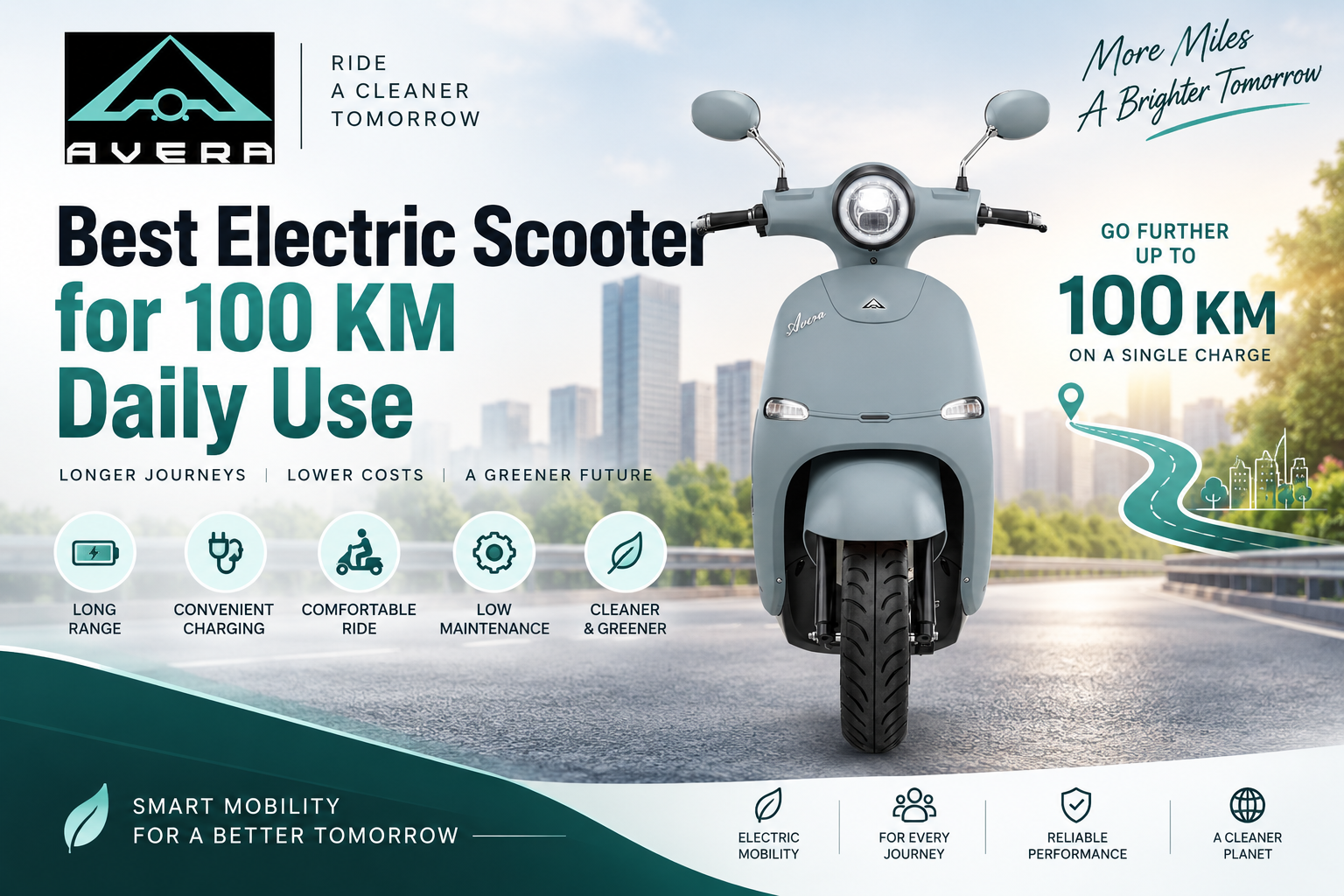
Why 100 KM Daily Riding Needs More Careful Planning
A daily ride of around 100 km is substantially different from a 15 km or 20 km commute. The scooter may be used for several hours every day, and even small differences in range, charging time, seating comfort or ride quality can become significant over time.
Riders looking for the Best Electric Scooter for 100 KM Daily Use should therefore evaluate the complete ownership experience. The vehicle should not only be able to cover the distance on paper; it should also remain practical under real traffic conditions, varying speeds, payload changes and everyday weather.
City riders can also explore AVERA's guide to the Best Electric Scooter for City Ride in India to understand how urban traffic conditions can influence EV selection.
Key Requirements for a 100 KM Daily Commute
- Adequate practical riding range
- Convenient and reliable charging
- Comfortable seat and riding posture
- Stable handling for longer journeys
- Good braking and tyre condition
- Useful instrumentation and battery information
- Accessible service support
- Suitable warranty coverage
1. Range Is the Most Important Starting Point
If your normal daily requirement is close to 100 km, choosing a scooter with exactly 100 km of claimed range may leave very little practical margin. Real-world range can vary according to speed, traffic, rider weight, pillion use, gradients, tyre pressure, weather and riding style.
That means the Best Electric Scooter for 100 KM Daily Use should ideally offer enough usable range to cover the normal commute plus a reasonable buffer. You may need extra kilometres for detours, errands, unexpected traffic diversions or an additional meeting after work.
AVERA's article on the Best Range Electric Scooter for Daily Use is useful for riders who want to understand range selection in more detail.
2. Understand Certified Range vs Real-World Range
Range figures are useful for comparing electric scooters, but riders should understand that test-cycle numbers and everyday results are not always identical.
High-speed riding generally consumes more energy than moderate-speed commuting. Frequent hard acceleration, heavy loads and steep roads may also affect battery consumption.
Someone searching for the Best Electric Scooter for 100 KM Daily Use should therefore ask how the scooter performs in normal urban and mixed-road conditions, not only what the brochure displays.
Riders who use intercity or faster roads can also read AVERA's guide about Electric Scooter Range on Highway.
3. Fast Charging Can Be Very Valuable
Charging time becomes especially important when daily distance is high. If your routine consumes a substantial portion of the battery each day, the scooter needs enough time to recharge before the next journey.
Some riders can easily charge overnight. Others may travel in shifts, return home late or need to use the scooter again during the day. In these situations, faster charging can improve flexibility.
AVERA discusses this topic in its guide to the Top Electric Scooter with Fast Charging in India.
For the Best Electric Scooter for 100 KM Daily Use, charging convenience can be just as important as range.
4. Plan Where You Will Charge Every Day
Before purchasing an electric scooter, decide exactly where charging will normally take place.
Home charging is often the most convenient arrangement for daily users. However, apartment residents and tenants should first confirm whether a suitable electrical connection is available near the parking location.
Riders travelling 100 km each day should avoid treating charging as an afterthought. A reliable routine can make EV ownership simple, while inconvenient charging can create unnecessary stress.
Before Buying, Ask:
- Can I charge safely at home?
- How long does a normal charge take?
- Can I charge at my workplace if necessary?
- What type of charger is provided?
- What electrical requirements apply?
- What happens if I need an additional charger?
5. Comfort Matters More on Long Daily Rides
A scooter may feel comfortable during a short showroom test but become tiring after 40 or 50 km. For a daily 100 km commute, ergonomics deserve serious attention.
Check the seat cushioning, rider posture, handlebar position, footboard space and suspension response. Also consider whether you frequently carry a pillion.
The Best Electric Scooter for 100 KM Daily Use should remain comfortable throughout longer journeys rather than simply looking attractive.
Male riders comparing ergonomics can also explore AVERA's guide to the Best Electric Scooter for Men in India.
6. Low Maintenance Becomes More Important at High Mileage
A rider travelling 100 km per day may cover roughly 2,500 to 3,000 km in a month depending on the number of riding days. Over a year, this can become substantial mileage.
Electric scooters use a simpler drivetrain than conventional petrol scooters because they do not rely on a combustion engine. However, tyres, brakes, suspension, bearings and electrical systems still require inspection.
Riders can learn more in AVERA's guide to a Low Maintenance Electric Scooter in India.
For the Best Electric Scooter for 100 KM Daily Use, reliable maintenance support can help keep the scooter available for everyday commuting.
7. Smart Features Can Improve Long-Distance Commuting
Electric scooters often include digital systems that help riders monitor battery status, range and riding information.
Depending on the model and variant, features may include digital displays, riding modes, battery indicators, connectivity functions and other convenience technologies.
AVERA covers this area in its guide to the Top Electric Scooter with Advanced Features.
For long-distance users, the most valuable technology is the technology that genuinely helps plan and manage the ride.
8. AVERA for Smart Commuting
AVERA's electric mobility approach is relevant to riders who want to replace or reduce dependence on petrol for regular commuting.
Long-distance commuters often need a vehicle that fits into a predictable daily schedule. A scooter used for office travel, business visits or regular city-to-suburb commuting should support the rider's actual travel pattern.
AVERA's guide to the Top Electric Scooter for Smart Commuting in India discusses how electric mobility can fit into everyday urban travel.
9. Electric Scooters for Working Professionals
Working professionals can be among the heaviest daily scooter users. A commute may involve home-to-office travel, customer visits, meetings, errands and the return journey.
A professional travelling close to 100 km every day needs predictable range and sufficient charging time before the next workday.
AVERA has a dedicated guide to the Best Electric Scooter for Working Professionals in India.
These same considerations are directly relevant when selecting the Best Electric Scooter for 100 KM Daily Use.
10. Is a 100 KM Daily Electric Scooter Suitable for Students?
Most students travel much shorter distances, but some may commute between cities, campuses, coaching centres and internship locations.
For long-distance student riders, total daily kilometres should be calculated before selecting a scooter. Charging access at home or hostel accommodation also needs to be confirmed.
Students can review AVERA's guide to the Best Electric Scooter for Students in India for additional student-focused considerations.
11. Can the Same Scooter Work for Family Use?
In many Indian households, a scooter is shared by more than one person. If your EV will be used for a 100 km commute on some days and family errands on others, comfort and accessibility should suit multiple riders.
Families can explore AVERA's article about the Best Electric Scooter for Family Use in India.
The Best Electric Scooter for 100 KM Daily Use can still be family-friendly, but range requirements should be calculated using the heaviest expected daily use.
12. How Much Daily Range Buffer Should You Keep?
A range buffer helps protect against everyday variations.
Suppose your normal route totals 92 km. Add a short detour for shopping and the journey may reach 100 km. Traffic diversion could push that figure higher.
This is why riders should avoid selecting a vehicle whose practical range barely matches their maximum daily requirement.
Example daily calculation:
Home to office: 38 km
Office to customer meeting: 12 km
Customer meeting to office: 10 km
Office to home: 38 km
Total: 98 km
In this example, choosing a scooter with only around 100 km of real-world capability would leave almost no flexibility. The Best Electric Scooter for 100 KM Daily Use should ideally give the rider breathing room beyond the routine distance.
13. Riding Style Can Make a Big Difference
Smooth acceleration and sensible speed can generally improve energy efficiency compared with repeated hard acceleration and high-speed riding.
Maintaining correct tyre pressure and avoiding unnecessary load can also support efficient operation.
If your commute involves mixed highway and city conditions, study AVERA's highway range guide before making a final decision.
14. Premium Features vs Practical Needs
A premium electric scooter can offer attractive styling, technology and a more refined ownership experience. However, someone riding 100 km each day should put practical requirements first.
Range, charging, comfort and service access should take priority over cosmetic extras.
Riders comparing premium options can still explore AVERA's article about a Premium Electric Scooter in India.
Ideally, the Best Electric Scooter for 100 KM Daily Use should offer both practicality and the features the rider genuinely values.
15. Why Service Support Matters for Long-Distance Riders
A scooter used occasionally can remain parked for a day without creating major inconvenience. A scooter used for a 100 km daily commute is different.
If the vehicle is unavailable, the owner may suddenly need expensive alternative transport. This makes service availability, spare parts and warranty support especially important.
Before buying, ask where the nearest authorised support point is located and what routine servicing is recommended.
16. AVERA in the Indian Electric Scooter Market
The EV market in India continues to expand, giving commuters more options across price and performance categories.
Riders evaluating AVERA can learn more through the guide to the Top Electric Scooter Brand in India.
You can also compare wider electric mobility considerations through the Top Electric Scooter in India 2026 and Top EV Scooter in India guides.
Buyers should compare current model specifications directly before selecting the Best Electric Scooter for 100 KM Daily Use.
17. Electric Scooter vs Other Electric Two-Wheelers
Some riders may also compare electric scooters with other electric two-wheeler formats.
Scooter-style vehicles typically prioritise everyday convenience, step-through usability and urban practicality, while different two-wheeler formats may prioritise different riding characteristics.
AVERA's guide to the Best Electric Two Wheeler in India provides broader category-level information.
18. Local Riding Conditions Matter
Road conditions, climate, traffic congestion and daily gradients vary significantly across Indian cities.
A route involving frequent flyovers, stop-start traffic and high temperatures may produce a different energy-consumption pattern from a smoother route at moderate speeds.
Riders in Andhra Pradesh can review AVERA's guide to the Best Electric Scooter for Vijayawada for a location-focused perspective.
19. Running Cost for 100 KM Every Day
Long-distance riders naturally care about operating cost. An electric scooter uses electricity instead of petrol, so cost per kilometre can differ significantly from conventional fuel-based vehicles.
However, exact savings depend on local electricity rates, vehicle efficiency, battery capacity, kilometres travelled and charging losses.
A rider covering 100 km every working day should calculate annual energy cost rather than looking only at one day's charging expense.
Total ownership cost should also include purchase price, insurance where applicable, service requirements, tyres and eventual battery-related considerations.
20. Safety Is Essential for Long Daily Commutes
Spending more time on the road naturally increases exposure to traffic. Safety should therefore be central when selecting the Best Electric Scooter for 100 KM Daily Use.
Use an appropriate certified helmet, keep tyres correctly inflated, inspect braking condition and ensure lights are functioning properly.
Riders should also take regular breaks if fatigue develops during unusually long continuous journeys.
Quick Buying Checklist
- Calculate your true daily distance
- Choose enough range with a useful buffer
- Confirm everyday charging access
- Check charging time
- Take a meaningful test ride
- Review battery and vehicle warranty
- Check service availability
- Evaluate seat and suspension comfort
- Confirm the current model specification before purchase
21. Frequently Asked Questions
1. Can an electric scooter handle 100 KM every day?
It can if the scooter's practical range, charging system, comfort and maintenance requirements match the usage. Always verify current model specifications and leave a range buffer rather than planning to use the complete available range every day.
2. What range should I choose for a 100 KM commute?
Your required practical range should exceed your normal daily distance. The exact buffer depends on your route, charging opportunities, traffic, speed and other real-world factors.
3. Is AVERA suitable for long daily commuting?
AVERA can be considered by riders exploring electric mobility for regular commuting. The correct model should be selected according to current range, charging, warranty, comfort and service specifications.
4. Is fast charging necessary for a 100 KM daily commute?
It is not always necessary if overnight charging comfortably fits your routine, but faster charging can provide greater flexibility for heavy daily users.
5. Does riding faster reduce electric scooter range?
Higher sustained speeds can increase energy consumption. Actual range also depends on payload, road conditions, tyre pressure, weather and acceleration patterns.
6. Can I use an electric scooter for highway commuting?
This depends on the scooter's legal category, performance, route and road conditions. Riders should confirm vehicle suitability and applicable road rules before using any scooter on faster roads.
7. Is an electric scooter comfortable for 100 KM daily riding?
Comfort varies between riders and models. Take an extended test ride where possible and evaluate seat design, suspension, riding posture and foot space.
8. Is maintenance expensive for high-mileage electric scooter users?
Electric drivetrains avoid several conventional engine service items, but high-mileage riders still need to budget for tyres, brakes, suspension checks and routine servicing.
9. Is an electric scooter practical for office commuting?
Yes, particularly when daily range and charging access align well with the route. AVERA also provides information specifically for working professionals.
10. Which is the Best Electric Scooter for 100 KM Daily Use?
There is no single model that is best for every rider. The right scooter depends on actual daily distance, real-world range, charging access, comfort, budget, warranty and local service support. Riders considering AVERA should compare current specifications and take a test ride before purchasing.
Final Thoughts: Choosing the Best Electric Scooter for 100 KM Daily Use
A 100 km daily commute requires more planning than ordinary short-distance riding. The scooter needs enough practical range, a dependable charging routine and comfort that remains acceptable over long hours of use.
For anyone searching for the Best Electric Scooter for 100 KM Daily Use, AVERA provides useful resources covering range, city commuting, fast charging, smart features, maintenance and everyday EV ownership.
The most important step is to evaluate the scooter based on your actual journey. Measure your daily kilometres, identify where you will charge, consider how much reserve range you need and verify the latest specifications directly before buying.
If your commute changes regularly, choose additional flexibility rather than selecting a vehicle that works only under ideal conditions. Long-distance users benefit most when their scooter has enough capability to handle both the normal routine and occasional extra travel.
A well-chosen electric scooter can make long-distance commuting more predictable and reduce dependence on petrol, but the decision should be based on practical requirements rather than one marketing number.
Explore Electric Mobility with AVERA
Discover AVERA electric mobility solutions and compare options for long-distance commuting, daily use and smarter electric travel.
Visit AVERA