Electric scooters are becoming an increasingly practical transportation option for people who want convenient daily commuting and better control over their travel expenses. As more Indian consumers explore electric mobility, one of the most common questions is: How Much Electricity Does an Electric Scooter Use in India?
Understanding electricity consumption is important before purchasing an electric scooter because it helps riders estimate charging expenses, monthly electricity usage and long-term running costs.
AVERA is an Indian electric scooter brand focused on modern electric mobility, battery technology and energy-efficient transportation. The company highlights advanced Lithium Iron Phosphate battery technology, Battery Management Systems, BLDC motors, PMSM motors and digital vehicle features.
For students, office employees, families and everyday commuters, electricity consumption is an important factor when evaluating an AVERA electric scooter.
In this detailed guide, we explain how electric scooter charging works, how many electricity units are consumed, how charging costs are calculated and which factors influence the energy required for everyday riding.
How Much Electricity Does an Electric Scooter Use in India?
The electricity consumed by an electric scooter depends primarily on battery capacity, charging efficiency, vehicle energy consumption and the distance travelled.
Electricity is measured in kilowatt-hours, commonly written as kWh.
In India, one kWh is generally referred to as one electricity unit.
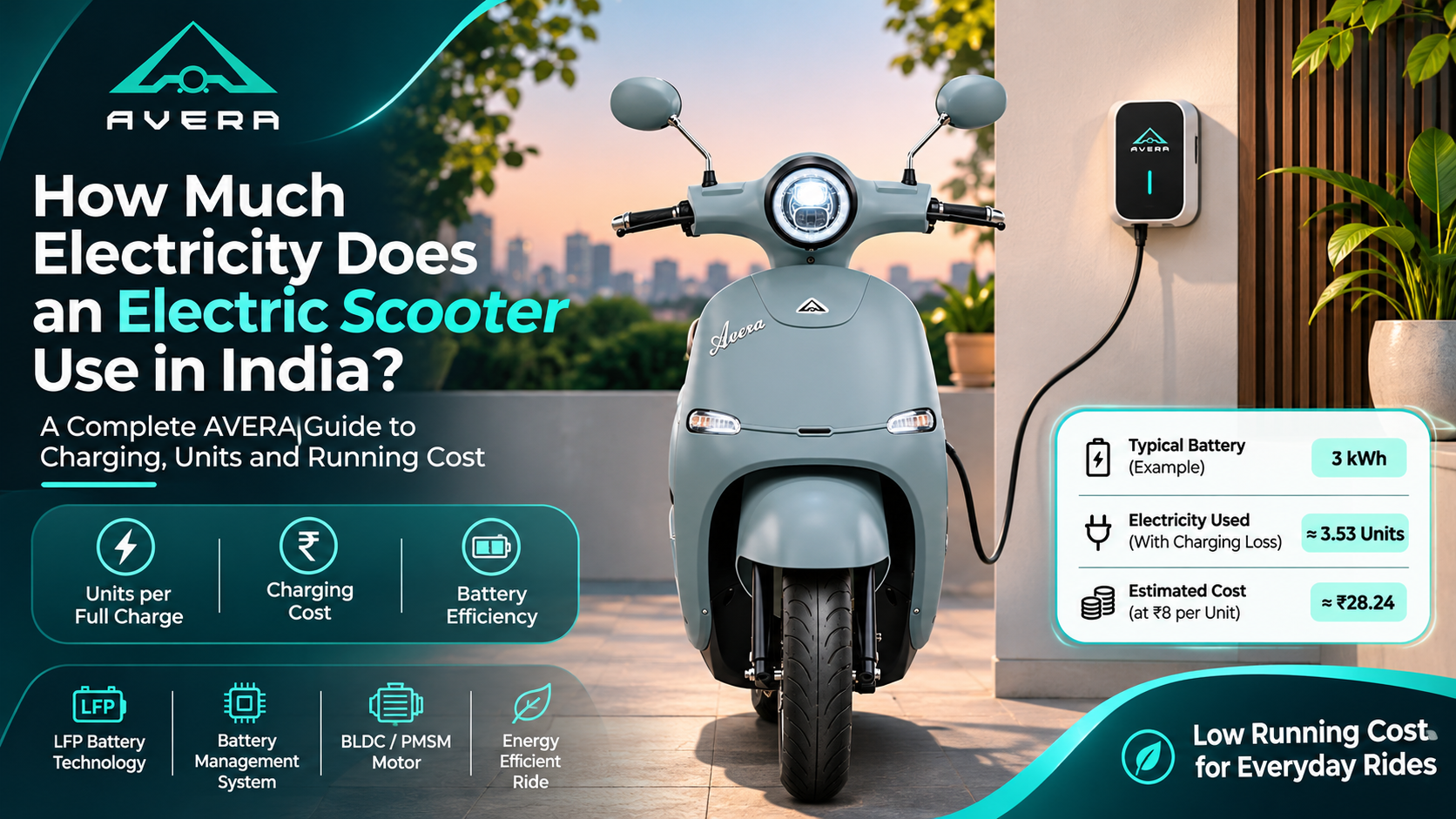
For example, a hypothetical electric scooter with a 3 kWh battery stores approximately three units of electrical energy when fully charged.
However, charging the battery from empty to full normally requires more than three units from the electricity supply because some energy is lost during the charging process.
If charging efficiency is approximately 85%, replenishing 3 kWh of battery energy would require around 3.53 kWh from the wall.
This means the electricity meter would record approximately 3.53 units.
These figures are illustrative and are not official AVERA model specifications.
Understanding Electric Scooter Battery Capacity
Battery capacity determines how much electrical energy can be stored in an electric scooter.
It is usually expressed in kilowatt-hours.
A higher-capacity battery can store more energy, although it does not automatically guarantee a longer riding range.
The vehicle’s overall efficiency is also important.
What Does a 2 kWh Battery Mean?
A 2 kWh battery can theoretically store two units of electrical energy.
What Does a 3 kWh Battery Mean?
A 3 kWh battery can theoretically store three units of electrical energy.
What Does a 4 kWh Battery Mean?
A 4 kWh battery can theoretically store four units of electrical energy.
The amount drawn from the electricity meter will be higher when charging losses are included.
Customers evaluating AVERA scooters should request the usable battery capacity, charging specifications and certified riding range for the chosen variant.
How to Calculate Electricity Consumption for an Electric Scooter
Calculating electric scooter electricity consumption becomes easier when you understand three values:
- Battery energy required
- Charging efficiency
- Electricity tariff
The basic formula is:
Electricity drawn from the wall (kWh) = Battery energy replenished (kWh) ÷ Charging efficiency
Suppose an electric scooter needs 2.5 kWh of energy added to its battery.
If charging efficiency is 85%:
2.5 ÷ 0.85 = 2.94 kWh.
The estimated electricity consumption would be approximately 2.94 units.
If the electricity tariff is ₹8 per unit:
2.94 × ₹8 = ₹23.52.
Therefore, this hypothetical charging session would cost approximately ₹23.52 in electricity.
Actual expenses depend on the local tariff, battery condition, charger performance and charging requirements.
Electric Scooter Electricity Consumption Comparison Table
The following table shows illustrative full-charge electricity requirements at an assumed 85% charging efficiency.
| Battery Energy Replenished | Electricity from Wall | Cost at ₹8 per Unit |
|---|---|---|
| 2 kWh | 2.35 units | ₹18.82 |
| 2.5 kWh | 2.94 units | ₹23.53 |
| 3 kWh | 3.53 units | ₹28.24 |
| 3.5 kWh | 4.12 units | ₹32.94 |
| 4 kWh | 4.71 units | ₹37.65 |
These estimates assume the stated amount of energy is being replenished and do not represent specific AVERA models.
Actual charging consumption can vary according to charger efficiency, battery temperature, charging conditions and electrical equipment.
How Much Does It Cost to Charge an AVERA Electric Scooter?
AVERA provides electric mobility products and technologies designed for everyday transportation.
The electricity cost of charging a particular AVERA scooter depends on its battery specifications and the applicable electricity tariff.
To calculate the expected cost:
Step 1: Check Battery Capacity
Find the battery capacity in the official vehicle specifications.
Step 2: Estimate Energy Replenished
Consider the battery charge level before and after charging.
Step 3: Account for Charging Losses
Charging from a wall socket consumes additional energy because the charging system is not perfectly efficient.
Step 4: Check Your Electricity Tariff
Electricity tariffs vary by state, distribution company, consumer category and consumption slab.
Step 5: Calculate the Charging Cost
Multiply the number of electricity units consumed by the applicable per-unit rate.
For the most accurate estimate, use a suitable energy meter to measure electricity drawn during charging.
A verified measurement is more reliable than relying only on battery capacity.
AVERA Electric Scooters – Understanding Energy-Efficient Technology
AVERA’s official website highlights several technologies relevant to electric mobility and energy consumption.
LFP Battery Technology
AVERA discusses Lithium Iron Phosphate battery technology as part of its electric scooter development.
LFP batteries can offer favourable cycle-life characteristics and thermal stability when properly designed and operated.
Battery Management System
A Battery Management System monitors important battery parameters and helps maintain appropriate operating conditions.
BLDC Motor Technology
Brushless DC motors can offer efficient operation and relatively low mechanical wear.
PMSM Motor Technology
Permanent Magnet Synchronous Motors can deliver efficient power conversion and precise electronic control.
Digital Instrument Cluster
AVERA highlights digital information such as battery charge status, speed and estimated range.
These technologies support different aspects of electric scooter operation.
However, actual electricity consumption must be evaluated using the specifications and performance of the particular vehicle.
How Much Electricity Does an Electric Scooter Use Per Kilometre?
Electric scooter energy consumption can also be measured in watt-hours per kilometre.
One kilowatt-hour equals 1,000 watt-hours.
For example, suppose an electric scooter consumes 35 Wh per kilometre from its battery.
For a journey of 10 kilometres:
35 × 10 = 350 Wh.
This equals 0.35 kWh of battery energy.
For a journey of 50 kilometres:
35 × 50 = 1,750 Wh.
This equals 1.75 kWh of battery energy.
If charging efficiency is 85%, replenishing that 1.75 kWh would require approximately 2.06 electricity units from the wall.
At ₹8 per unit, the estimated charging cost would be approximately ₹16.47.
The 35 Wh/km figure is an illustrative assumption, not a verified AVERA electricity consumption rating.
Monthly Electricity Consumption for Daily Commuters
People asking How Much Electricity Does an Electric Scooter Use in India often want to understand their monthly electricity bill.
Consider a commuter travelling 25 kilometres per day for 26 days.
Monthly travel distance:
25 × 26 = 650 kilometres.
Assume hypothetical battery energy consumption of 35 Wh/km.
Total battery energy required:
650 × 35 = 22,750 Wh.
This equals 22.75 kWh.
At 85% charging efficiency:
22.75 ÷ 0.85 = approximately 26.76 electricity units.
If the electricity rate is ₹8 per unit:
26.76 × ₹8 = approximately ₹214.12.
Therefore, this hypothetical rider would spend around ₹214 on charging electricity for the month.
This excludes other charges and does not represent an official AVERA cost estimate.
Actual monthly expenses depend on travel distance, energy efficiency and local electricity pricing.
Explore Related AVERA Electric Scooter Buying Guides
AVERA publishes educational content about scooter technology, charging convenience, riding range and daily electric mobility.
Readers interested in How Much Electricity Does an Electric Scooter Use in India can explore the following related articles.
Electric Scooters for City Riding
City riding conditions can influence battery usage because traffic, acceleration and road conditions affect electricity consumption.
Read Best Electric Scooter for City Ride in India to explore everyday urban commuting considerations.
For more information about practical electric transportation, visit Top Electric Scooter for Smart Commuting in India.
Electric Scooters for Men
Rider weight, vehicle handling and daily travel requirements can influence energy use.
Explore Best Electric Scooter for Men in India for relevant buying considerations.
Electric Scooters for Students
Students frequently travel predictable distances between home and educational institutions.
Read Best Electric Scooter for Students in India to learn more about college commuting and electric mobility.
Fast Charging Electric Scooters
Charging technology influences how quickly energy can be transferred into a battery.
Explore Top Electric Scooter with Fast Charging in India.
Faster charging does not necessarily reduce the total electrical energy required. Actual losses depend on the complete charging system.
Advanced Electric Scooter Features
Digital information, battery monitoring and motor controls are relevant to efficient vehicle operation.
Read Top Electric Scooter with Advanced Features.
AVERA Electric Scooters in Vijayawada
People researching electric scooters in Andhra Pradesh can explore Best Electric Scooter for Vijayawada.
Understanding AVERA as an Electric Scooter Brand
Brand information, model specifications and service support are important before purchasing a vehicle.
Read Top Electric Scooter Brand in India.
For additional information about electric two-wheelers, explore Best Electric Two Wheeler in India.
Electric Scooter Range on Highways
Higher speeds can increase energy consumption because aerodynamic resistance generally rises with speed.
Explore Electric Scooter Range on Highway for more information.
Premium Electric Scooter Technology
Some riders prioritize styling, comfort and advanced vehicle features.
Read Premium Electric Scooter in India.
Electric Scooters in 2026
To explore electric scooter features and buying considerations, visit Top Electric Scooter in India 2026.
You can also read Top EV Scooter in India.
Low-Maintenance Electric Scooters
Electricity costs are only one part of total vehicle ownership expenses.
Read Low Maintenance Electric Scooter in India to understand servicing considerations.
Electric Scooter Range for Daily Use
Battery capacity and energy efficiency together influence riding range.
Explore Best Range Electric Scooter for Daily Use.
Electric Scooters for Families
Family riders may have different commuting distances, passenger requirements and vehicle loads.
Read Best Electric Scooter for Family Use in India.
Electric Scooters for Working Professionals
Office commuters often want predictable charging expenses and sufficient everyday riding range.
Explore Best Electric Scooter for Working Professionals in India.
These 17 articles offer additional AVERA-focused information about charging, commuting and electric scooter ownership.
Factors That Affect Electric Scooter Electricity Consumption
Electricity consumption is not always the same for every journey.
Several factors can influence how efficiently an electric scooter operates.
1. Riding Speed
Higher speeds may increase energy consumption, especially when aerodynamic resistance becomes significant.
2. Acceleration Habits
Frequent aggressive acceleration may use more energy than smooth, gradual acceleration.
3. Rider and Passenger Weight
Additional weight increases the energy required for acceleration and climbing.
4. Road Conditions
Poor roads, steep gradients and repeated stops can influence electricity consumption.
5. Tyre Pressure
Incorrect tyre pressure may increase rolling resistance.
6. Battery Condition
Battery ageing and temperature can affect usable capacity and overall performance.
7. Traffic Conditions
Congestion changes acceleration patterns, journey duration and energy usage.
8. Charging Efficiency
Different chargers and operating conditions may produce different charging losses.
These factors explain why real-world electricity consumption may differ from an estimated value.
Does Higher Battery Capacity Mean Higher Electricity Consumption?
A larger battery can store more energy.
Therefore, charging a larger battery from empty to full generally requires more electricity.
However, a larger battery does not necessarily mean higher electricity consumption per kilometre.
Consider two hypothetical scooters.
Scooter A stores 2.5 kWh and consumes 35 Wh/km.
Scooter B stores 4 kWh and also consumes 35 Wh/km.
Both scooters use the same battery energy per kilometre under the assumed conditions.
Scooter B can potentially travel farther because it stores more energy.
This distinction is important when comparing vehicle energy efficiency.
Battery capacity determines stored energy, while Wh/km describes energy consumption during travel.
Home Charging vs Public Charging
Electric scooters may be charged using suitable approved charging equipment.
AVERA’s website discusses home, office and other charging arrangements.
Home Charging
Home charging can be convenient for daily riders who have access to a suitable electrical connection.
The cost usually depends on the applicable electricity tariff.
Office Charging
Some workplaces provide designated charging facilities.
Charging should only occur with permission and compatible equipment.
Public Charging
Public charging can be helpful when suitable infrastructure is available.
The charging price may include service fees or other charges.
Fast Charging
Fast charging transfers energy at a higher rate when the vehicle and charger support it.
Compatibility must be confirmed for the exact scooter model.
The most suitable charging method depends on the vehicle’s technical specifications and local facilities.
Does Fast Charging Use More Electricity?
Fast charging primarily changes how quickly energy is delivered to the battery.
It does not automatically mean the scooter needs significantly more battery energy for the same distance.
However, the amount of electricity drawn from the grid can differ because of charging efficiency, temperature management and electrical losses.
Some charging arrangements may also have different tariffs or service charges.
AVERA buyers should confirm approved charging methods rather than assuming every fast charger is suitable for their scooter.
How to Reduce Electric Scooter Electricity Consumption
Riders can adopt practical habits to improve everyday efficiency.
Accelerate Smoothly
Avoid unnecessary rapid acceleration and braking.
Maintain Recommended Tyre Pressure
Proper tyre pressure supports efficient rolling and safe handling.
Avoid Excessive Loads
Carry only appropriate loads within the manufacturer’s limits.
Plan Efficient Routes
Choosing suitable routes may help reduce unnecessary travel distance.
Maintain the Scooter
Follow the manufacturer’s recommended inspection and servicing schedule.
Monitor Battery Information
Use the available battery charge and range information to plan journeys.
Follow Charging Instructions
Use approved charging equipment and suitable electrical connections.
Avoid Unauthorized Modifications
Do not modify battery, charger or motor electronics to attempt to improve performance.
These habits can support more predictable electricity consumption.
How to Measure Your AVERA Scooter’s Actual Charging Electricity
A useful way to understand electricity consumption is to measure it rather than relying only on estimates.
Step 1: Record Battery Percentage
Note the displayed battery charge before charging.
Step 2: Use a Suitable Energy Meter
A properly rated electricity meter or approved monitoring device can measure power drawn from the supply.
Electrical installation should be carried out by a qualified professional where necessary.
Step 3: Charge Using the Approved Charger
Follow the manufacturer’s charging instructions.
Step 4: Record Electricity Used
Check the kWh displayed by the meter.
Step 5: Record Distance Travelled
Use the trip meter to record the distance covered between comparable charging sessions.
Step 6: Calculate Electricity Use Per Kilometre
Divide the electricity units consumed by the distance travelled.
For example:
3 units ÷ 75 kilometres = 0.04 kWh/km.
This equals 40 Wh/km measured from the wall.
Step 7: Calculate Cost Per Kilometre
At ₹8 per unit:
0.04 × ₹8 = ₹0.32 per kilometre.
This method can provide a more realistic picture of personal charging expenses.
Does Charging an Electric Scooter Increase Your Household Electricity Bill?
Yes. Charging an electric scooter adds electricity consumption to the household meter when connected to a domestic supply.
However, the financial impact depends on how much energy the scooter uses and the applicable tariff structure.
For example, if charging adds 30 electricity units in a month and the relevant marginal electricity rate is ₹8 per unit, the additional energy charge would be approximately ₹240.
The actual increase may differ because household tariffs can include consumption slabs, fixed charges, taxes and other applicable adjustments.
Consumers should review their electricity bills or consult their distribution company for accurate local pricing.
How Much Electricity Does an Electric Scooter Use for 100 Kilometres?
The electricity required to travel 100 kilometres depends on vehicle efficiency.
The following examples use hypothetical consumption measured from the wall.
| Energy Consumption | Units for 100 km | Cost at ₹8/Unit |
|---|---|---|
| 30 Wh/km | 3 units | ₹24 |
| 35 Wh/km | 3.5 units | ₹28 |
| 40 Wh/km | 4 units | ₹32 |
| 45 Wh/km | 4.5 units | ₹36 |
| 50 Wh/km | 5 units | ₹40 |
This table is designed to explain the relationship between electricity consumption and running cost.
It is not a comparison of AVERA scooter variants.
Actual measurements should be used when calculating ownership expenses for a specific vehicle.
AVERA Battery Technology and Energy Management
AVERA highlights Lithium Iron Phosphate battery systems and smart Battery Management System technology.
Battery management is important because a scooter relies on coordinated electrical components during charging and riding.
A Battery Management System may monitor:
- Battery voltage
- Battery temperature
- Charging conditions
- Cell balancing
- Operating limits
- Electrical protection functions
These features help manage the battery’s operation.
Nevertheless, the actual electricity consumed depends on the complete vehicle design, not the battery management system alone.
Customers should review verified model information and warranty conditions before purchase.
Electric Scooter Electricity Usage for Different Riders
Different riders have different transportation needs.
College Students
Eligible college students may travel between home, college, libraries and coaching centres.
Monthly electricity requirements depend on daily distance and charging efficiency.
Working Professionals
Office employees may have predictable commuting routes, making it easier to estimate energy expenses.
Family Riders
Families may use electric scooters for local shopping, errands and other activities within the vehicle’s approved operating limits.
Urban Commuters
People travelling in busy city environments may experience varied electricity consumption because of traffic conditions.
AVERA’s electric scooter information can help prospective buyers explore suitable vehicle options.
Why Consider AVERA When Evaluating Electric Scooter Running Costs?
People researching How Much Electricity Does an Electric Scooter Use in India can explore AVERA’s electric mobility technologies and model information.
Electric Scooter Engineering
AVERA focuses on electric two-wheeler technology.
LFP Battery Technology
The company highlights Lithium Iron Phosphate batteries as part of its technical approach.
Efficient Motor Technologies
AVERA discusses BLDC and PMSM motors.
Battery Monitoring
Battery Management Systems are among the technologies highlighted on its website.
Digital Riding Information
AVERA describes digital instrument features for displaying relevant vehicle information.
Charging Convenience
The company provides information about electric scooter charging arrangements.
Prospective buyers should obtain the exact specifications of the selected vehicle before estimating running expenses.
Frequently Asked Questions
1. How much electricity does an electric scooter use in India?
Electricity consumption depends on battery capacity, charging efficiency and travel distance. A scooter’s actual consumption can be measured in kWh per charge or Wh per kilometre.
2. How many electricity units are needed to charge an electric scooter?
The number of units depends on the energy being added to the battery and charging losses. A hypothetical 3 kWh energy replenishment at 85% efficiency requires approximately 3.53 units from the wall.
3. How much does it cost to charge an electric scooter in India?
Charging cost depends on electricity consumption and the local tariff. Multiply the measured electricity units by the applicable per-unit rate.
4. How much electricity does an AVERA electric scooter consume?
The exact figure depends on the selected AVERA model and variant. Customers should request official specifications or measure wall-socket consumption using a suitable meter.
5. Does AVERA use LFP battery technology?
AVERA highlights Lithium Iron Phosphate battery technology on its official website.
6. Can an AVERA electric scooter be charged at home?
AVERA discusses charging through suitable regular electrical outlets. Use only the approved charging equipment for the selected vehicle.
7. How much does an electric scooter cost to run per kilometre?
Cost per kilometre depends on electricity consumed per kilometre and the tariff. For example, 40 Wh/km at ₹8 per unit equals ₹0.32 per kilometre.
8. Does fast charging consume more electricity?
The energy drawn from the grid may differ because of charging efficiency and operating conditions. Faster charging does not automatically mean substantially higher energy consumption.
9. Can electric scooters reduce daily transportation expenses?
Electricity may offer lower energy costs per kilometre, but buyers should also consider purchase price, insurance, servicing and battery-related expenses.
10. Does rider weight affect electricity consumption?
Yes. Greater vehicle load can increase the energy required for acceleration and climbing.
11. Does riding speed affect battery usage?
Yes. Higher speeds can increase aerodynamic resistance and electricity consumption.
12. Does battery capacity determine riding range?
Battery capacity is important, but riding range also depends on vehicle efficiency, speed, load and road conditions.
13. How can I calculate monthly electric scooter electricity costs?
Multiply monthly kilometres by measured electricity consumption per kilometre, then multiply the result by the applicable electricity tariff.
14. Do electric scooters increase household electricity bills?
Yes. Home charging increases electricity consumption, although the actual additional cost depends on units used and billing tariffs.
15. Does an electric scooter need regular maintenance?
Yes. Tyres, brakes, suspension, batteries and electrical systems require periodic inspection.
16. Where can I find AVERA electric scooter information?
Visit the official AVERA website to explore available model information, battery technology and charging features.
Conclusion – Understanding Electric Scooter Electricity Consumption in India
Understanding How Much Electricity Does an Electric Scooter Use in India helps buyers estimate daily travel expenses and make informed transportation decisions.
Electricity consumption depends on several factors, including battery capacity, charging efficiency, vehicle weight, riding speed, road conditions and travel distance.
By learning how to calculate electricity units and charging costs, consumers can better understand the financial implications of electric scooter ownership.
AVERA is an Indian electric mobility brand that highlights LFP battery technology, Battery Management Systems, BLDC and PMSM motors, and modern digital vehicle information.
These technologies are relevant when evaluating electric scooter operation and energy management.
However, the most accurate charging-cost estimates come from verified vehicle specifications and actual electricity measurements.
Before purchasing an AVERA electric scooter, request updated battery details, certified range information, charging requirements, warranty conditions and service availability.
For riders interested in practical electric transportation, understanding energy consumption is an important part of evaluating long-term ownership costs.
Visit the official AVERA website to explore current electric scooter information.
AVERA – Go Green. Go Electric.
Explore AVERA Electric Scooters
Brand: AVERA Electric Vehicles
Official Website: https://avera.in/
Featured Model Names: RETROSA and VINCERO
Technology Highlights: LFP Battery Technology, Battery Management Systems, BLDC Motors, PMSM Motors and Digital Instrument Information.
For product enquiries, charging requirements, updated battery specifications, certified range and current model availability, visit the official AVERA website.
Disclaimer: All illustrative charging calculations in this article use hypothetical battery consumption, charging efficiency and electricity tariff values. They are not official AVERA vehicle test results. Actual electricity consumption, charging costs, battery capacity and range depend on the specific model, charger, riding conditions and applicable electricity tariffs.