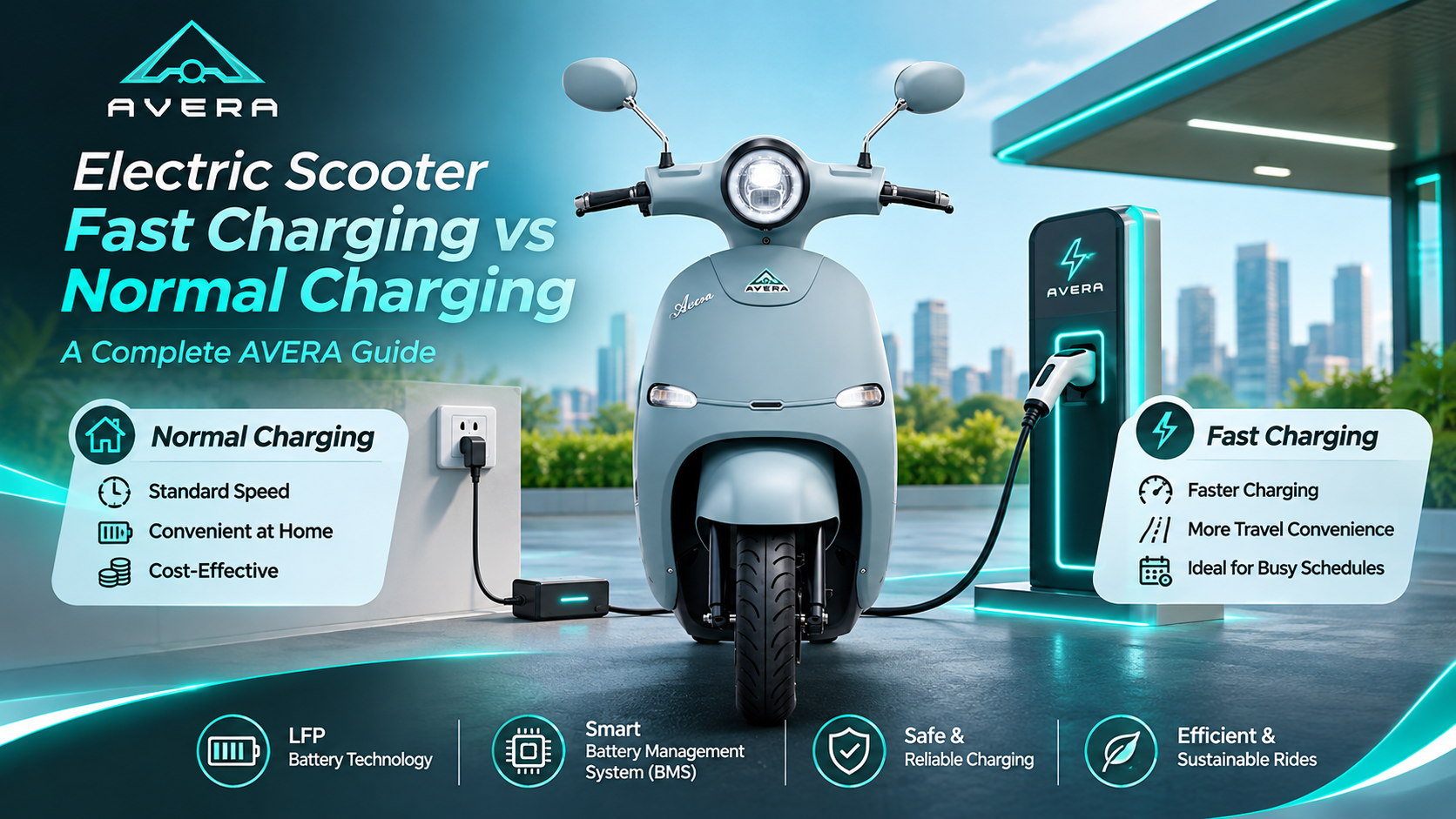
Electric scooters are transforming the way people travel across India. From daily office commuting and college transportation to family outings and everyday shopping, electric mobility offers an increasingly practical option for personal transportation.
When purchasing an electric scooter, customers often compare riding range, battery capacity, vehicle design, motor performance, and overall running costs. However, one important consideration is how the electric scooter is charged.
Understanding Electric Scooter Fast Charging vs Normal Charging can help riders choose the right charging arrangement according to their daily travel needs.
Some electric scooter owners prefer the convenience of charging at home or the office. Others may benefit from faster charging arrangements when they need to travel more frequently.
AVERA is an Indian electric scooter brand that focuses on advanced battery technology, electric motor engineering, and modern mobility solutions.
The company’s official website highlights Lithium Iron Phosphate battery technology, Battery Management Systems, and charging arrangements for electric mobility.
This complete guide explains the differences between fast charging and normal charging, how battery systems work, the importance of charging compatibility, electricity consumption, and how to choose an appropriate charging method for AVERA electric scooters.
What Is Electric Scooter Charging?
Electric scooter charging is the process of transferring electrical energy into a rechargeable battery.
The battery stores energy that is later used to power the scooter’s electric motor and other electrical components.
Unlike a petrol-powered vehicle, an electric scooter does not require conventional fuel to operate.
Instead, the rider connects approved charging equipment to a suitable electrical power source.
The charging system helps regulate the transfer of energy into the battery.
Several factors influence the charging process:
- Battery capacity
- Charger power output
- Battery voltage
- Charging current
- Battery temperature
- Battery Management System
- State of charge
- Charging compatibility
- Electrical supply conditions
These factors help explain why charging times can vary between vehicles and charging arrangements.
Electric Scooter Fast Charging vs Normal Charging – Understanding the Difference
The main difference between fast charging and normal charging is the rate at which electrical energy can be transferred into the battery.
What Is Normal Charging?
Normal charging, also called standard charging or conventional charging, generally uses a lower charging power.
It is commonly associated with approved home or workplace charging equipment.
Normal charging can be convenient for riders who have sufficient time to recharge their scooter between journeys.
For example, a person who uses an electric scooter for office commuting may prefer charging during an extended period when the vehicle is parked.
What Is Fast Charging?
Fast charging is designed to supply electrical energy at a higher rate than a conventional charging setup, provided the scooter supports it.
This can reduce the time required to add useful energy to the battery.
Fast charging may be especially helpful for riders who travel repeatedly throughout the day.
However, not every electric scooter can use every fast charger.
Charging compatibility must be verified for the exact AVERA model and variant.
AVERA Electric Scooter Charging Technology
AVERA highlights electric mobility technology designed around battery performance, energy management, and charging convenience.
Its published information discusses:
- Lithium Iron Phosphate battery technology
- Smart Battery Management System
- Charging through suitable electrical outlets
- Regular wall-socket charging
- Compatible charging infrastructure
- Digital battery charge information
- Electric motor efficiency
The company also discusses faster charging as part of its battery technology.
However, buyers should obtain the current model-specific charging specifications before assuming that a particular AVERA scooter supports a certain charging speed or public charging connector.
AVERA LFP Battery Technology and Charging
LFP stands for Lithium Iron Phosphate.
It is a type of rechargeable lithium-ion battery chemistry used in various electric mobility applications.
AVERA highlights LFP battery technology on its official website.
Potentially Long Battery Cycle Life
LFP battery chemistry can provide relatively long cycle life under suitable operating conditions.
The actual service life depends on battery quality, temperature, charging behaviour, depth of discharge, and overall pack design.
Thermal Stability
LFP chemistry offers favourable thermal stability compared with certain other lithium-ion chemistries.
However, this does not mean an LFP battery is completely immune to overheating, damage, or electrical faults.
Battery Management
The Battery Management System plays an important role in monitoring and protecting battery operation.
Charging Compatibility
Battery chemistry alone does not determine whether fast charging is supported.
The entire vehicle charging architecture must be designed for the approved charging equipment and power level.
For AVERA buyers, this distinction is important when comparing Electric Scooter Fast Charging vs Normal Charging.
How Does Normal Charging Work?
Normal charging generally uses approved charging equipment connected to a suitable electrical supply.
The charger converts and regulates electrical power according to the battery’s charging requirements.
Step 1: Connect the Approved Charger
Use the charging equipment specified by the vehicle manufacturer.
Step 2: Connect to a Suitable Power Source
The electrical connection must meet the manufacturer’s requirements.
Step 3: Begin Charging
The charging system begins transferring energy into the battery.
Step 4: Monitor Battery Status
Where supported, the digital instrument cluster or charging equipment displays charging information.
Step 5: Complete Charging
Follow the manufacturer’s instructions for charging completion and disconnecting the equipment.
Normal charging is particularly convenient when a rider has access to a suitable charging location and does not need an immediate recharge.
How Does Fast Charging Work?
Fast charging uses higher charging power than a conventional charging arrangement.
The charger, vehicle electronics, battery pack, and Battery Management System must work together to manage the process.
Higher Power Delivery
A compatible fast charger can transfer energy more quickly than a lower-powered standard charger.
Battery Monitoring
The charging system monitors electrical and thermal conditions.
Charging Rate Adjustment
Charging power may change as battery charge increases.
Automatic Charging Control
The system can reduce or stop charging when appropriate protection limits are reached.
Compatibility Requirements
The vehicle must support the relevant charger output, voltage range, current limits, connector, and communication method where applicable.
AVERA customers should use only charging equipment approved for their model.
Electric Scooter Fast Charging vs Normal Charging – Key Comparison
1. Charging Speed
Normal charging generally takes longer because energy is transferred at a lower rate.
Fast charging may reduce charging time when the vehicle and charger are compatible.
2. Daily Convenience
Normal charging can be convenient for predictable daily commuting.
Fast charging may be more useful when a rider needs additional energy between multiple journeys.
3. Charging Equipment
Standard charging commonly uses equipment suited to home or workplace electrical connections.
Fast charging may require specialized hardware and compatible infrastructure.
4. Installation Requirements
A suitable standard charging arrangement may be straightforward to use when the existing electrical supply meets manufacturer requirements.
Higher-power charging arrangements may require additional electrical capacity or installation work.
5. Charging Cost
The cost of charging depends primarily on the electricity consumed, tariff, and charging losses.
Public fast charging may also involve service or usage fees.
6. Battery Temperature
Higher charging currents can increase thermal demands.
Proper battery design and charging management are essential.
7. Battery Longevity
Charging frequency, temperature, state of charge, and the manufacturer’s charging limits affect long-term battery health.
Fast charging does not automatically damage a battery, but repeated high-power charging under unsuitable conditions may increase stress.
8. Rider Requirements
The best charging method depends on how frequently the scooter is used and how much time is available for charging.
Explore Related AVERA Electric Scooter Buying Guides
AVERA publishes informative articles about charging, battery range, city commuting, advanced technology, and electric scooter ownership.
These resources can help customers understand Electric Scooter Fast Charging vs Normal Charging alongside other practical considerations.
Electric Scooters for City Riding
City commuters often travel through traffic, intersections, and congested roads.
Read Best Electric Scooter for City Ride in India to explore electric scooter considerations for urban transportation.
For additional guidance, explore Top Electric Scooter for Smart Commuting in India.
Electric Scooters for Different Riders
People have different commuting needs depending on their travel distance, lifestyle, and riding preferences.
Explore Best Electric Scooter for Men in India.
Students researching suitable electric transportation can read Best Electric Scooter for Students in India.
AVERA Fast Charging Information
Charging technology is an important part of modern electric mobility.
Read Top Electric Scooter with Fast Charging in India for an additional guide to charging speed, battery performance, and practical charging considerations.
Advanced Electric Scooter Technology
Modern electric scooters combine battery systems, electric motors, and digital features.
Explore Top Electric Scooter with Advanced Features.
Electric Scooters in Vijayawada
AVERA is associated with Vijayawada, Andhra Pradesh.
Customers can explore Best Electric Scooter for Vijayawada for additional location-focused electric mobility information.
Learn More About AVERA
Understanding the electric scooter manufacturer is important before purchasing.
Read Top Electric Scooter Brand in India.
For a broader buying perspective, explore Best Electric Two Wheeler in India.
Electric Scooter Range and Charging
Battery range and charging convenience are closely connected.
Riders planning longer journeys can read Electric Scooter Range on Highway.
For daily commuting, explore Best Range Electric Scooter for Daily Use.
Premium AVERA Electric Scooters
Vehicle design, technology, comfort, and battery performance are important considerations for premium electric mobility.
Read Premium Electric Scooter in India.
You can also explore Top Electric Scooter in India 2026.
For additional information, read Top EV Scooter in India.
Maintenance and Ownership
Proper charging is one part of electric scooter maintenance.
Read Low Maintenance Electric Scooter in India.
Electric Scooters for Families
Families may prioritize ease of use, seating comfort, charging access, and sufficient daily range.
Explore Best Electric Scooter for Family Use in India.
Electric Scooters for Working Professionals
Office commuters often prefer convenient charging and predictable travel costs.
Read Best Electric Scooter for Working Professionals in India.
These 17 AVERA articles provide additional information about electric scooter ownership, charging technology, and everyday mobility.
Which Charging Method Is Better for Daily Office Commuting?
Office commuters often follow a predictable travel schedule.
For example, consider a rider who travels 20 kilometres to work and 20 kilometres home.
The total daily distance is 40 kilometres.
If the scooter has sufficient usable range and the rider can charge conveniently between trips, normal charging may be practical.
Advantages of Normal Charging for Office Use
- Convenient when the scooter remains parked for several hours
- Suitable for planned charging schedules
- May use approved home charging equipment
- Reduces dependence on public infrastructure
When Fast Charging May Help
Fast charging may be useful when a rider unexpectedly needs to travel a greater distance or has limited time between journeys.
However, this advantage applies only when the scooter supports the approved faster charging system.
Fast Charging vs Normal Charging for Students
Students frequently use electric scooters for college commuting, coaching classes, and other local journeys.
Normal charging may be sufficient for students with shorter, predictable daily distances.
Fast charging may be helpful when the scooter is used frequently and compatible facilities are available.
Before choosing, students should evaluate:
- Daily travel distance
- Charging availability at home
- Vehicle range
- Charging time
- Applicable licensing requirements
- Battery warranty
- Charging equipment compatibility
The ideal charging arrangement is the one that meets practical needs safely and reliably.
Fast Charging vs Normal Charging for Family Use
Family electric scooter usage can vary throughout the day.
A scooter may be used for office commuting, shopping, visiting relatives, and other routine journeys.
Normal charging can be convenient when the vehicle is parked overnight.
Fast charging may be useful for households requiring quicker turnaround between multiple journeys.
However, families should prioritize approved charging equipment, appropriate electrical safety, and the manufacturer’s guidance.
How Much Electricity Does an Electric Scooter Need?
Electric scooter electricity consumption depends on the battery, charger efficiency, and energy being replenished.
Battery capacity is commonly expressed in kilowatt-hours, abbreviated as kWh.
One electricity unit equals one kWh.
Example Calculation
Suppose a hypothetical electric scooter needs 3 kWh of energy added to its battery.
Assume the electricity price is ₹8 per kWh.
The basic energy cost is:
3 × ₹8 = ₹24.
However, charging systems experience energy losses.
If the electrical socket supplies 3.4 kWh for that charging session, the electricity cost becomes:
3.4 × ₹8 = ₹27.20.
These figures are illustrative and are not official AVERA charging specifications.
Is Fast Charging More Expensive?
Fast charging is not necessarily more expensive simply because it is faster.
However, a public charging provider may charge additional service fees, and charging losses can vary.
Always compare the actual electricity tariff and any applicable charging fees.
Does Fast Charging Affect Battery Life?
Battery ageing is influenced by several factors.
These include:
- Charging current
- Battery temperature
- Charging frequency
- Depth of discharge
- Battery pack construction
- State of charge
- Battery Management System
- Long-term storage conditions
Higher charging power can create additional thermal and electrical demands.
However, a properly designed charging system manages power within the battery’s intended limits.
The correct approach is to follow AVERA’s model-specific charging recommendations.
Do not assume that using an unauthorized higher-powered charger will provide safe fast charging.
What Is a Battery Management System?
A Battery Management System, or BMS, is an electronic system that monitors important battery operating conditions.
AVERA highlights BMS technology as part of its LFP battery system.
Voltage Monitoring
Battery voltage is monitored to help manage operation.
Overcharge Protection
Protective systems help prevent charging outside the intended voltage limits.
Cell Balancing
Battery packs contain multiple cells, and cell balancing supports more consistent operation.
Thermal Management
Battery temperature influences charging behaviour and performance.
Charging Control
The charging system can regulate charging according to the battery’s operating requirements.
A suitable BMS is important for both standard and faster charging arrangements.
Can You Charge an AVERA Electric Scooter at Home?
AVERA’s official website discusses charging through regular electrical outlets.
However, actual charging arrangements depend on the scooter’s approved equipment and electrical requirements.
Important Home Charging Guidelines
Use the charger specified for the vehicle.
Make sure the electrical socket and supply are suitable.
Avoid damaged plugs and cables.
Do not overload electrical connections.
Follow the manufacturer’s ventilation and charging instructions.
Keep charging equipment away from unsuitable moisture exposure.
Do not modify charging connectors or battery components.
If you have concerns about the electrical installation, consult a qualified electrician.
Can AVERA Electric Scooters Use Public Fast Chargers?
Public charging stations use different connectors, power ratings, voltage ranges, and communication systems.
AVERA discusses public and fast charging arrangements on its website, but this does not establish universal compatibility for every scooter variant.
Before using a public charger, confirm:
- Approved connector type
- Vehicle voltage requirements
- Charger power compatibility
- Battery charging limits
- Required charging communication
- Manufacturer authorization
- Availability of the charging facility
Never use improvised adapters or unauthorized charging modifications.
Why Does Charging Slow Down Near Full Battery Capacity?
Battery charging does not always occur at a constant rate.
Charging power may decrease as the battery approaches a higher state of charge.
This can help control voltage, temperature, and other battery conditions.
As a result, charging from a low level to a partial charge may occur at a different average rate than charging the final portion of the battery.
This is why charging-time claims should specify the percentage range being measured.
For example, a charging time quoted from 20% to 80% cannot be directly compared with a charging time quoted from 0% to 100%.
How to Choose the Right Charging Setup for Your AVERA Scooter
Step 1: Understand Your Daily Travel
Calculate the distance travelled during a typical day.
Step 2: Check the Certified Range
Confirm the official specifications for your selected AVERA variant.
Step 3: Identify Available Charging Locations
Consider home, office, and approved public charging facilities.
Step 4: Ask About Charging Time
Request the model-specific normal and faster charging specifications where applicable.
Step 5: Confirm Equipment Compatibility
Use only approved charging equipment.
Step 6: Review Warranty Conditions
Understand whether charger use, modifications, or charging practices affect warranty coverage.
Step 7: Consider Your Schedule
Choose charging arrangements that fit your travel routine.
Common Electric Scooter Charging Mistakes to Avoid
Improper charging habits can create inconvenience or safety concerns.
Using Incompatible Chargers
A charger should never be selected solely because its connector appears to fit.
Ignoring Electrical Supply Requirements
An unsuitable electrical connection can create hazards.
Using Damaged Cables
Damaged charging equipment should not be used.
Making Unauthorized Modifications
Modifying the battery pack or charging system may create serious electrical and fire risks.
Ignoring Warning Indicators
Unexpected charging errors or battery warnings should be investigated through appropriate service support.
Assuming Every Scooter Supports Fast Charging
Actual fast-charging capability must be confirmed for the specific AVERA model.
Frequently Asked Questions About Electric Scooter Fast Charging vs Normal Charging
1. What is the difference between fast charging and normal charging?
Normal charging generally uses lower power and takes longer. Fast charging supplies energy at a higher rate when the vehicle supports the appropriate charging equipment.
2. Which is better for an AVERA electric scooter?
The best option depends on the scooter’s approved charging systems, daily travel distance, and available charging facilities.
3. Does AVERA offer fast charging technology?
AVERA discusses faster charging and LFP battery technology on its official website. Confirm actual fast-charging capability for the selected model and variant.
4. Can I charge an AVERA scooter at home?
AVERA discusses regular wall-socket charging. Use only approved equipment and a suitable electrical supply.
5. Is normal charging suitable for daily commuting?
Yes. Normal charging may be practical when the rider has sufficient time to recharge between journeys.
6. Does fast charging reduce battery lifespan?
Higher charging power can increase battery stress under some conditions. Actual effects depend on battery design, temperature, charging controls, and usage.
7. Is fast charging more expensive?
Charging cost depends on electricity consumption, tariffs, losses, and any public charging fees.
8. How long does an AVERA electric scooter take to charge?
Charging time depends on the selected model, battery capacity, charger output, and state of charge. Request official specifications for your variant.
9. Does an LFP battery support fast charging?
LFP chemistry can be used in fast-charge-capable systems, but compatibility depends on the complete battery pack and charging architecture.
10. Can I use any public fast charger?
No. Charger compatibility must be confirmed before connecting the vehicle.
11. Why does charging slow down near 100%?
Charging power may decrease at higher battery charge levels to keep operating conditions within appropriate limits.
12. Is overnight charging convenient?
It can be practical when permitted by the manufacturer’s instructions and supported by suitable charging equipment and electrical facilities.
13. Does AVERA use a Battery Management System?
Yes. AVERA highlights BMS features for monitoring, overcharging protection, and cell balancing.
14. Is fast charging necessary for short city rides?
Not necessarily. Riders with predictable short journeys may find normal charging sufficient.
15. Where can I learn more about AVERA charging technology?
Visit the official AVERA website to explore battery technology, charging information, and product enquiries.
Conclusion – Electric Scooter Fast Charging vs Normal Charging: What Should AVERA Riders Choose?
Understanding Electric Scooter Fast Charging vs Normal Charging is important for anyone planning to purchase or use an electric scooter.
Normal charging can offer a convenient solution for riders who have sufficient time to recharge at home or work.
Fast charging can be useful for riders who need additional battery energy within a shorter period, provided their vehicle supports compatible charging equipment.
Neither method is automatically the best choice for everyone.
Battery capacity, charging compatibility, daily travel distance, electricity costs, battery health, and charging infrastructure should all be considered.
AVERA highlights LFP battery technology, smart Battery Management Systems, electric motor engineering, and charging convenience as part of its electric mobility approach.
Before choosing a charging arrangement, confirm the current model specifications, approved charging equipment, charging time, battery warranty, and available service support.
For city commuters, students, working professionals, and families, an appropriate charging routine can make everyday electric mobility more convenient.
Explore the latest AVERA electric scooter information and learn more about modern battery technology through the company’s official website.
AVERA – Smart Electric Mobility for Everyday India.
Explore AVERA Electric Scooters
Brand: AVERA Electric Vehicles
Official Website: https://avera.in/
Electric Scooter Models: RETROSA and VINCERO model information, subject to current availability.
Charging Information: Visit the official website or contact AVERA for approved charger specifications, model compatibility, and current technical information.
Visit AVERA’s official website to learn more about electric scooters, charging technology, battery systems, and product enquiries.
Disclaimer: This article provides general educational information about electric scooter charging. Battery specifications, charger compatibility, fast-charging capability, charging duration, certified range, warranty terms, and product availability vary by model and configuration. Always follow AVERA’s current model-specific charging instructions and use manufacturer-approved equipment.